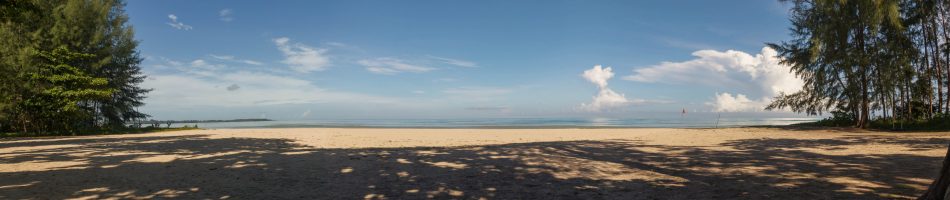
I visited Lamkum Beach on a quiet day, and the first thing I noticed was how empty it felt. The beach stretches out along the Gulf of Thailand with no crowds, no loud music, and very little development. The sand is simple and natural, and the shoreline feels open and unpolished. Small fishing boats were scattered along the coast, and the sound of the waves was steady and calm.
Lamkum Beach is far from the busier parts of Prachuap Khiri Khan, about 42 km from the city, but close to Thap Sakae, which is only 3.8 km away. That distance seems to keep it peaceful. I spent most of my time walking along the water, watching the light change over the sea. It’s not a beach for activities or nightlife, but for quiet moments and slow time, it’s exactly right.
I arrived in Ban Krut without a plan — and that was the point. The beach felt wide and empty. The sand was soft, the water calm.
I walked for a long time, passing only a few fishermen and one or two couples. No vendors. No noise. Just waves and wind moving through the trees.
That evening, I ate grilled fish at a small local place by the road — plastic chairs, a cold drink, perfect food. I went to sleep early with the sound of the ocean outside my window.
The next morning, a few locals walked the beach. Fishing boats moved quietly in the distance. It felt private, like the beach belonged to only a handful of people.
Ban Krut didn’t try to impress me. It didn’t entertain me. It simply gave me space — and that’s exactly why I’ll remember it.
I visited Ban Krut Railway Station on a quiet lunchtime. The station is small and unhurried, with a single platform and only a few tracks. There’s nothing fancy about it, but that’s part of its charm.
The station sits close to the village, so there’s no rush or noise. Just a few locals waiting, and the sound of a train pulling away. It felt less like arriving at a transport hub and more like arriving in a beach town. From the station, Ban Krut Beach is only a short ride away.
Palm trees line the road, and everything moves at an easy pace. Compared to larger stations in Thailand, this one feels personal and relaxed, like it belongs to the community rather than serving crowds of tourists. Ban Krut Railway Station isn’t a place you come to see. It’s a place you pass through quietly on the way to the sea. And that’s what makes it memorable.
The wooden houses of Ban Krut sit quietly along small roads and sandy paths, weathered by sun and sea air. Most are raised on stilts, practical and unfussy, built to let the breeze pass through and the rain run underneath. The wood is faded and uneven in places, showing years of use rather than neglect. Some houses have wide verandas with plastic chairs, fishing nets hung to dry, or motorbikes parked beneath the floor. Life feels visible here, not staged. There’s no attempt to modernize them for show. These houses exist because they work. They suit the heat, the pace, and the people who live in them.
Walking past, you get the sense that nothing is rushed and nothing needs fixing unless it truly breaks. Like the railway station, Ban Krut’s wooden houses aren’t attractions. They’re just part of daily life. And that quiet honesty is what makes them memorable.
San Chao Phra Shiva Shankar (ศาลเจ้าพระศิวะศังกร) is a small Hindu shrine dedicated to Lord Shiva in Thap Sakae District, Prachuap Khiri Khan, Thailand. It sits near the coast, not far from Thap Sakae Beach, just off Highway 1029.
We weren’t planning to stop there at all. We simply came across the shrine while driving toward the beach and decided to pull over. The shrine is in the Ang Thong sub-district, an area known for its quiet beaches and laid-back local life.
With the sea nearby and hardly anyone around, the place felt calm and reflective, a peaceful pause in the middle of our road trip. Despite its small size, it left a strong impression and turned into one of those unexpected moments that stay with you.
Ban Krut Fishing Village -Prachuap Khiri Khan province-Thailand
Ban Krut is an old fishing village in Prachuap Khiri Khan province, about 360 kilometers south of Bangkok. It has attracted some local tourists over the years, but it never feels like a resort town. The fishing village is still there, still working. Boats leave early, the day’s catch is sorted on the shore, and life moves at a pace set by the sea, just as it always has.
Arulmigu Rajamariamman Temple stands in the middle of Johor Bahru’s busy streets, but the moment you step near it, the mood shifts. The bright gopuram, the detailed carvings, and the steady flow of devotees give the place a calm weight. My visit was brief, but the colours, scents, and quiet movement inside made it easy to slow down and look closer. These photos capture what drew my eye as I walked through this landmark of faith and history.
I spent a day walking through Johor Bahru with no schedule except to see what the city would show me. From busy streets and old shophouses to quiet corners by the water, JB revealed a mix of energy and ease that was easy to enjoy. These photos capture the small moments that stood out along the way, the scenes that make the city feel alive and welcoming.
My Visit to Johor Bahru and Street Art Walk During my visit to Johor Bahru, I was amazed by how the city blends modern energy with old-town charm.
I started my day exploring the JB Old Town, where every corner tells a story — from vintage cafés and local shops to the colorful street art that brings the walls to life.
The Street Art Walk was the highlight of my trip. Hidden in narrow alleys and along quiet streets, the murals capture the spirit of Johor — its culture, people, and daily life. Each painting felt like stepping into a different scene, full of color and creativity.
After wandering through the art alleys, I enjoyed some local food at a nearby kopitiam — a perfect way to end the day surrounded by art, flavors, and friendly faces.
Nelson Head Lighthouse isn’t one of those towering, dramatic lighthouses you picture on postcards — it’s actually just a keeper’s cottage with a light attached. That’s part of what makes it so charming. It sits on a grassy headland above Nelson Bay, and when you walk up, the first thing you notice is the view: wide, open water stretching across Port Stephens.
The place has this gentle, lived-in feeling. You can wander through the old cottage, which is now a little maritime museum, and it feels like stepping back into a slower time when people actually lived here, keeping watch night after night. The museum is run by volunteers, so there’s always someone with a story or two about the area’s history. It’s the kind of spot where you don’t just come for the “lighthouse” (because honestly, there’s no tall tower to climb), you come for the atmosphere.
There’s a tea room on site, perfect if you want to just sit, sip, and take in the ocean breeze. It’s quiet, unpretentious, and one of those places where the mix of history and view makes you want to linger a little longer.
Why It Matters (My Take) I like Nelson Head Light because it’s humble but rich in character — unlike tall, imposing towers, this one feels more “human size”. You can imagine the lighthouse keepers living right there, looking out the window to guide ships. It’s a place where you really feel connection: to seafaring history, to community volunteers who keep it alive, and to nature around the headland.
On my trip to Australia, I found myself in a little outback town called Kurri Kurri, and it completely stole my heart. At first glance, it looks like any small town—quiet streets, modest shops, friendly faces. But then you notice the walls.
They’re alive with color, covered in murals that tell the story of the town and its people. Every corner holds a surprise: miners at work, local wildlife, families gathered together, moments of history captured in paint.
It feels like the town has decided to write its autobiography on its own walls, making sure no visitor misses what matters here.
Wandering around, I couldn’t help but slow down. The murals aren’t just art—they’re pride, memory, and identity woven into everyday life. And you can feel how much the locals cherish them.
They talk about the paintings like old friends, pointing out favorites and sharing the stories behind them. It was a feast for the eyes, yes, but also for the heart. Kurri Kurri isn’t just a stop on a map—it’s a place that wears its soul on its walls.
I got here after walking the Tilligerry Nature Walk, where the path wound through bushland and then suddenly opened to the estuary. The track skirted the shoreline, and there it was—spread wide before me, the tide pulled back like a stage curtain.
What a scene to feast my eyes on. Long stretches of wet, glistening sand shimmered in the sunlight, each ripple catching the light like glass. The trees edged the exposed flats, their roots half-buried, reaching into the mud as if they too were holding on to the tide. The sun was full in my face, warm and unrelenting, but I didn’t care. It seemed to sharpen everything—the brightness of the sand, the shimmer of the water left in shallow pools, the dark silhouettes of birds scattered across the flats.
For a while I just stood there, taking it in. It wasn’t just a view; it was a feeling—of stillness, of openness, of being caught between the forest at my back and the wide estuary breathing in front of me.
Birubi Beach is one of those places that sticks with you. The first time I stood at the lookout, I couldn’t believe the dunes just kept rolling on and on — a sea of sand that felt like another planet.
Walk a few steps down and suddenly you’re on wide, golden beach with the Pacific stretching out in front of you.
What I love about Birubi is the mix of energy and calm. A place of quiet space where it’s just you, the wind, and the ocean. The dunes themselves are the real showstopper. Along with the Camel trains lol. A memorable visit I will not forget for a long time


 Journeys From A Small Room