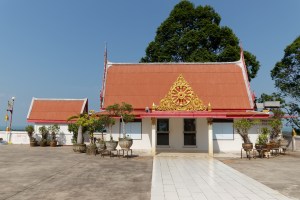
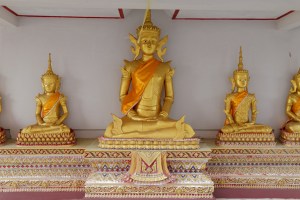
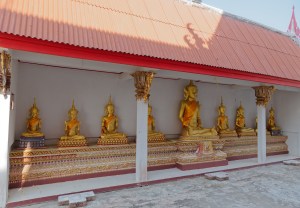
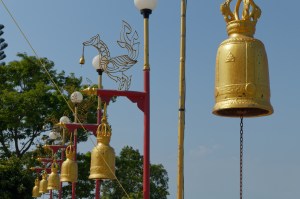
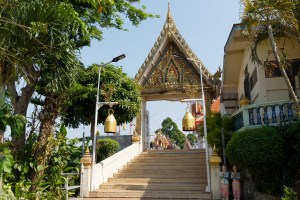
Wat Khao Suvan Pradit (Wat Khao Suwan Pradit) It was founded by one of the respectable Buddhist clerics from Southern Thailand. The temple stands on top of a 45-meter hill. Driving up in the car wasn’t as bad as some temples I have driven too and even the car park(which is large) his a great viewpoint in itself.
You can see the pagoda with relics. Although during my visit the temple was closed.
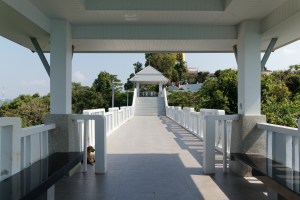
The temple stands on a Cape crane, so that there are incredible views of the area and the Don Sak River, flowing into Samese Bay. And at nautical breadth, of course. The two stilted viewpoints one each side allow you to almost feel as though you are over the sea.
Again the views are spectacular and well worth the visit, I could’ve spent all day there….
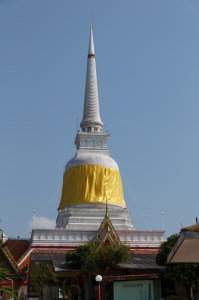
The Coral Pagoda that sits in Khao That, otherwise known as Por Thao Khao That.
This temple is 1,000 years old and is revered as a sacred area that’s used as a place to pay homage.
Apart from the Helter skelter drive up to it, its views are stunning and well worth the twisty road. My visit there was breathtaking as I looked out around some of Thailand’s most beautiful Countryside and hills.
It was apparently built by Chinese immigrants on their way to Surat Thani. When they stopped there for a break the local people told them, Surat Thani already has a Pagoda, so they built the Coral one there instead and apparently as legend goes there is treasure (of some sort) hidden within it!
Note there is no shade on the actual Pagoda area, and it was very very hot underfoot (shoes not allowed)
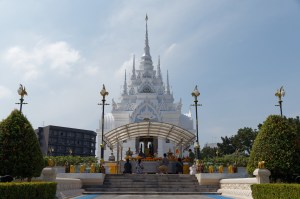
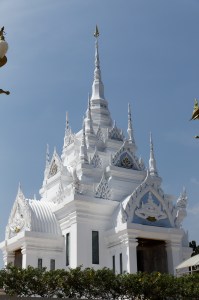
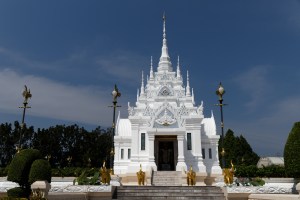
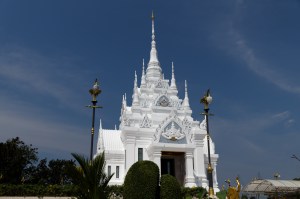
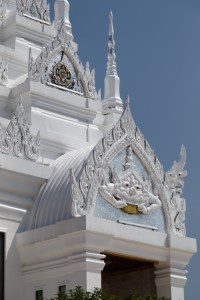
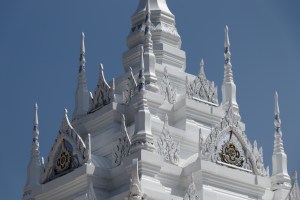
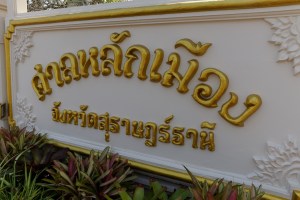
During my visit to Surat Thani recently I stopped by one of the most stunning City Pillar shrines I have ever seen.
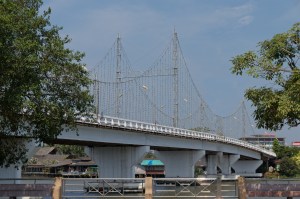
It is located near the Tapee River which runs alongside the road that separates it from the busy road, and you can get a good look at the suspension bridge from by the gates.
This city pillar is made from wood of the Golden Shower Tree (CasiaFitsula). (it actually looks like white marble). The top of the pillar is carved into a 4-faced Avalo kite. Vara Bodhisattva looking in the 4 directions.
This is a common style of the city pillars around Thailand. On the large hair curls, there is a Buddha image in the attitude of meditation, which is considered as the guardian of the direction, according to Srivijaya’s belief. Moreover, wood carving of this pillar shows delicate floral motifs in Srivijaya style.
A well-kept shrine which is considered by many to be the symbol of the city, the City Pillar Shrine or San Lak Muang is located in the heart of the city. Standing near the Tapee River, this shrine is lit up colourfully at night and is a great spot to spend some time in the city.
Just got back from my break and have got some lovely photos of places I have visited.
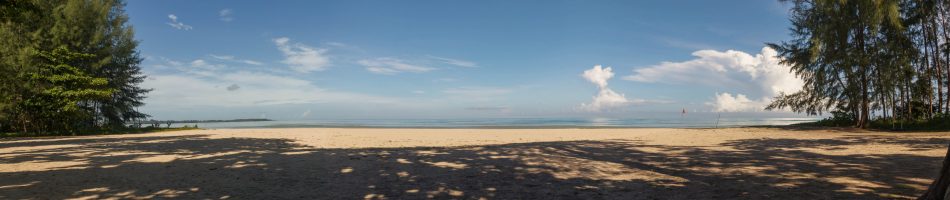
Today we start with Haad Kwang Pao Beach, which when i arrived there was empty and I had the place to myself, heaven! But for how long?
Haad Kwang Pao beach is about 14 kilometer in the north of Khanom it is well posted from the main road.
The beach itself is formed like a halfmoon and fine sandy. some resorts and beach bars are located in the back, but it seems that not many tourists found the road to kwang pao beach. it was really empty, and we were the only tourists we saw. at kwang pao beach…generally on the different beaches of the Khanom area mostly Thai people take their holidays. This depends on the cheap prices for resorts and restaurants, which still exist in that region.
we had wind and waves and we just moved hip deep into the water, but it was deep enough to swim, as the beach slopes gently to the sea and so kwang pao is perfect for families with small children.
The beach is well protected…at the Northend are cliffs located…at the south end there’s a pier with a few seafood restaurants and shops. the vegetation directly on the beach is reduced, because behind the resorts and restaurants is where the beach road is located.
The atmosphere at kwang pao beach was really quiet and peaceful, with just the sound of the waves breaking on the shore. we were alone at the beach the whole time I was taking photos.
This is a natural heritage site too, so pink dolphins, turtles and other marine life can be in the offing.
During my visit to Banteay Chhmar, I saw pictures of the Lions at the Baray (Lake). I have never seen anything quite like this before so this became a “must see” visit during one of our tours.
We reached it at the peak of the day when it was very dry and hot, so we didn’t cross the bridge to the Mebon on the Island. Instead we explored the steps and Lions at the edge of the Lake.
Banteay Chhmar’s baray lies approximately 7-800 metres east of the main temple site and measures some 800 metres by 1.6 kms. Alignment is as per Banteay Chhmar, so slightly north of east-west. The baray today is filled with paddy fields rather than water but a mebon temple is located in the centre of the reservoir.
In 2020, the local authorities have restored the west terrace of the baray, where they discovered a large immaculate sandstone lion buried in the baray, along with a range of other carved stones. The stone terrace has now been restored using old and new blocks to replace those that are too damaged or missing.
What you see in this slideshow is it’s current restored state 2022.
On our return from Banteay Chhmar to Siem Reap (Cambodia), we stopped at this beautiful stone mason’s garden. Whilst I see these as a common feature here in Thailand, and not too dissimilar is this Cambodian one.
Quite often because I am travelling from one place to another, I don’t often have time to stop and take in the enormous amount of work and skill that goes into these sculptures.
They do differ, especially when it comes to the Buddhas/Gods and other deities. I could have spent longer here, photographing them all, but I think this gives anyone a good flavour of what is there.
Starting my visit to Cambodia in December 2022, just around the corner from my hotel was this beautiful and auspicious Wat, Wat Botum.
Wat Botum means “Temple of the Lotus Blossoms” is a colorful temple in the center of Phnom Penh. In Cambodian known as Preah Vihear Wat Botumvatey, the serene and peaceful temple has recently been restored.
Wat Botum is one of the oldest temples in Phnom Penh. King Ponhea Yat ordered construction of the temple during his reign in the first half of the 15th century.
The viharn, the assembly hall, has recently been restored.
Inside the viharn a golden Buddha in meditation pose is seated on a pedestal. In front of it is a Reclining Buddha. The wall behind the image is adorned with a painting of a forest and the Bodhi tree the Buddha meditated under when reaching enlightenment.
The ceiling is adorned with colorful paintings depicting Buddhist stories. Which you will throughout this slideshow.
During my first ever visit to Angkor Wat I tried to do too much and consequently missing great temples (like this one) at the expense of others. Thankfully on my return in December 2022, I was able to visit the ones I missed. This one is The Baphuon Temple. which quickly has become one of my favourites!
\Baphuon is a beautiful 11th century “temple-mountain” with steep stairs leading visitors to a terrace which offers one of the best views in the Angkor Archaeological Park. Archaeologists believe that this pyramid-style temple, located within the city of Angkor Thom, was probably among the most impressive of the Angkor temples in its day.
Though it was originally dedicated to the Hindu god Shiva, Baphuon was converted to a Buddhist temple in the 15th century. As a result of this conversion, hidden on the west-facing section of the third enclosure wall is a giant reclining Buddha. The brickwork forming the reclining Buddha image is nine meters (30 feet) tall and 70 meters (230 feet) long. The statue was built into the west side of the temple’s second level. You may be able to see in my photos about halfway through the slideshow.
And no! I did not climb the stairway! it was too hot and too steep for me!
During my visit to Phnom Penh in December 2022, one of my “must do” visits was the Royal Palace.
On my last visit to Phnom Penh in 2013 the Royal Palace was partially closed, because on 15 October 2012, former Cambodian King and Prime Minister Norodom Sihanouk died at the age of 89, in Beijing, China, after suffering health issues. had died the year before, meaning it was closed for a whole year.
Home to Cambodia’s official royal residence, the grounds of Phnom Penh’s Royal Palace and Silver Pagoda are awash with regal structures, intimate temples, collections of gifts from foreign leaders and murals that paint a picture of the country’s past. Identified by the iconic high yellow walls that shelter the site, the Royal Palace and Silver Pagoda are one of the most popular tourist attractions in the city.
The dazzling, spectacular Grand Palace is undoubtedly the most famous landmark in Bangkok. It’s one must-see sight that no visit to the city would be complete without. It was built in 1782 and for 150 years was the home of the Thai King, the Royal court and the administrative seat of government.
The Grand Palace of Bangkok is a grand old dame indeed, that continues to have visitors in awe with its beautiful architecture and intricate detail, all of which is a proud salute to the creativity and craftsmanship of the Thai people. Within its walls were also the Thai war ministry, state departments, and even the mint. Today, the complex remains the spiritual heart of the Thai Kingdom.
Within the palace complex are several impressive buildings including Wat Phra Kaew (Temple of the Emerald Buddha), which contains the small but famous and greatly revered Emerald Buddha that dates back to the 14th century.
The robes on the Buddha are changed with the seasons by HM The King of Thailand – an important ritual in the Buddhist calendar. Thai Kings stopped living in the palace around the turn of the 20th century, but the palace complex is still used to mark all kinds of other ceremonial and auspicious happenings.
The palace complex, like the rest of Ratanakosin Island, is laid out very similar to the palaces of Ayutthaya, the glorious former capital of Siam which was raided by the Burmese. The Outer Court, near the entrance, used to house government departments in which the King was directly involved, such as civil administration, the army and the treasury. The Temple of the Emerald Buddha is located in one corner of this outer court.
The Central Court is where the residence of the King and halls used for conducting state business were located. Only 2 of the throne halls are open to the public, but you’ll be able to marvel at the exquisite detail on the facades of these impressive structures.
The Inner Court is where the King’s royal consorts and daughters lived. The Inner Court was like a small city entirely populated by women and boys under the age of puberty. Even though no royalty currently resides in the inner court, it is still completely closed off to the public.
Then there’s the impressive Dusit Hall, rated as perhaps the finest architectural building in this style, and a museum that has information on the restoration of the Grand Palace, scale models and numerous Buddha images.
Music free under creative commons licence, from youtube music library
Title: Fern by ann annie
In conclusion of this trilogy of street Art in Kata-Phuket, this area down the sidewalk to the small canal to the Kata beach, suns a wall with more modern and free form murals and wall art.
This area was also earmarked for urban renewal, which as all things is slow.
You can still walk down this canal path and see these murals, there were so many more but I think this gives you a good flavour of what’s there.
So following on from Pt1 ,Kata Palm Square Street Art- Phuket Pt1, I’ll put the link in this video which will take you right to it if you’ve missed it.
The photo project on this area of Kata was quite extensive , so I had to break it down into 3 pts, this is no.2! be sure to hit the like and follow button so you can be notified when they come out in the next few days!
Part of Kata’s regeneration scheme after coming out of Covid, this is a great way of brightening up the area for locals and visitors alike.
Look out for pt3 coming soon!
Music free under creative commons licence from You tube music library
Titles;Bonfire by An Jone