Earlier this year I stopped at an unfinished building that I had kept passing from time to time. It was easily accessible from the road and had been in its current state for at least the two years I have lived in Phuket. Always interested in Architecture of all sorts I stopped to photograph this “unfinished project”. Which for all the info I could find was supposed to be finished in three years! Sadly it seems that the funds/donations ran out and it is left for the future, when some benefactor may leave some large sum of money so it may be finished.
Also named as Kew Ong Tai De Am Rawai, I couldn’t find anymore than the translation below about this place. What appeared to be a great vegetarian, community effort that ran out of funds. None the less an interesting visit and view of what might have been and what still might be one day!
Co-construct the Kew Ong Tai Tam Temple Center of Dharma Practice And eat vegetables throughout the year. By Thewasan Kew Ong Tai Tam (Rawai) located at 60 Moo 6, Rawai Subdistrict, Mueang Phuket District It is a land belonging to the “Sukkaew” family, formerly owned by Father Lamead Sukkaew and Mother Lamead Sukkaew. And both of you Had a wish for this land to be the construction of the Kew Ong Tai Te Temple When he died, the said land became ownership of the heir. And the heirs who hold all rights have inherited the spirit of the parents And jointly hand over the said land of approximately 2 rai, almost 3 rai to the Kew Ong Tai Tam Temple (Rawai). And has been carrying out the ceremony to eat vegetables throughout the year 2006 until His Majesty Kew Ong Taitae He has assigned the Lord Oun Kong to climb Tae. As Lord Aam manages to build a temple And has appointed an official construction committee With the ceremony of laying the main pole on May 5, 2012 already Therefore immediately proceeded the construction Expected to be completed within 3 years, ie in the year 2558
By Thewasan Kew Ong Tai Tam (Rawai) located at 60 Moo 6, Rawai Subdistrict, Mueang Phuket District It is a land belonging to the “Sukkaew” family, formerly owned by Father Lamead Sukkaew and Mother Lamead Sukkaew. And both of you Had a wish for this land to be the construction of the Kew Ong Tai Te Temple When he died, the said land became ownership of the heir. And the heirs who hold all rights have inherited the spirit of the parents And jointly hand over the said land of approximately 2 rai, almost 3 rai to the Kew Ong Tai Tam Temple (Rawai). And has been carrying out the ceremony to eat vegetables throughout the year 2006 until His Majesty Kew Ong Taitae He has assigned the Lord Oun Kong to climb Tae. As Lord Aam manages to build a temple And has appointed an official construction committee With the ceremony of laying the main pole on May 5, 2012 already Therefore immediately proceeded the construction Expected to be completed within 3 years, ie in the year 2558, however, at the Shrine of Kyushu Ong Ah, the titration (Rawai) There is a story about the history. “Maha Pho Footprint” by Mother Lamed Which is a villager with good hearts Has a wonderful wisdom, touches according to beliefs To bring down the Bodhi tree growing on the Phrao Duan tree and plant it Mae Lamead brought the Bodhi tree to walk around, ready to plant many times until she found this point. Which is the point where Ong Ong Tai Tao has his footprint Therefore bowed to worship around the Buddha’s foot as a preliminary And is the origin of “Maha Pho Footprint” said.
While Mr. Arun Soros, Mayor of Rawai Sub-District, said that for the festival of the Yom Kippur Festival of Phuket residents Of the local government organization Has supported the tradition for a long time Both on facilitating the participants to eat vegetables To get comfortable Including supporting various factors To be used during the festival as well
As for the construction of the Kew Ong Taiteam Temple (Rawai), the municipality invites the people of faith to donate money. Although the construction has progressed a lot. But people can still donate money When this temple is completed, it will be a beautiful place that will promote tourism in the Rawai area as well.
So during Chinese New Year we managed a short four day break to Kho Phi Phi, one of the few Islands still running boat services. This is one of the two main beaches we visited during our stay.
The arrival point and central area of Koh Phi Phi, Tonsai Bay is a crowded busy area overlooked by Tonsai Village.
Tonsai Bay is the main arrival and departure hub for Koh Phi Phi as it is deep water. The bay is stretched out along a 2km long cliff which, as it heads to the east, is punctuated with promontories and smaller beaches.
Tonsai Bay is unsurprisingly flanked by the beaches of Tonsai East and Tonsai West. While it initially appears a scenic spot on arriving at Koh Phi Phi, the water at Tonsai Bay tends to have a fair bit of boat traffic continually coming in and out of the bay. As this is where the main Pier is for drop of and embarking on other Island Journeys.
Music free under creative commons licence from You tube music library Music: The Future Ancient Now by Nathan Moore
In February this year (2021) I was able to take a short break to the beautiful island of Koh Phi Phi, not that I would say that hoards of tourists packed over every inch of sand is beautiful, BUT there are no tourists at this present time, except for local Thais from the mainland and those of us who are expats here from working or in my case retirement.
So back to the beautiful Phi Phi, one of the few Islands still running ferries. This video is from the day I took one of my obligatory, walkabouts, and I was struck by two things, the intense colour and beauty of the sea around this area, and the sadness of so many boats tied up and not working. The streets empty and most businesses closed and shuttered up. There were a few places open and serving food and taking guests, but at this present time it is a shadow of it’s former self. Still a Jewel of an Island and even more stunning with less crowds.
One thing we did love seeing were all the cats, no dogs are allowed on the Island, but there were many cats, and friendly ones. The locals feed them as do the few tourists that come to visit, bags of kitty cookies are available in most stores.
Tonsai Bay is the bustling heart of Phi Phi. The bay hosts Phi Phi Island’s main village, and it is the main arrival port in Phi Phi. Here, there are no cars or roads, only footpaths. The village is located on an isthmus, for which Phi Phi is famous, with Tonsai Bay on the south side and Loh Dalum (Dalum Bay) on the north.
Before 14:30, when the last ferry leaves, the streets are busier with day-trippers and people arriving/departing. After that, the island is more relaxed and the difference is tangible. In the evening the streets fill again with diners looking for a place to eat. Additionally, as most business is done at night, the tour shops, dive shops and every other kinds of shop come to life. Later on, some isolated nightlife areas heat up; especially on the east side of the village and of the bay.
Phi Phi is a very bohemian type of place; after all, bicycles and long-tail boats are the only alternatives to walking.
Music credit to :The Future Ancient Now by Nathan Moore Free under creative commons licence from You Tube music library
My recent trip on a Catamaran included stopping off at some beautiful Islands close to Phuket.
My favourite one was Koh Racha, where the water is crystal clear and the sand is white and so so soft.
As there is no jetty as such you are picked up by a long tail boat and ferried to a floating pontoon, an aerobics session in itself getting to the beach as it bobs up and down in the water!
The water was so calm and clear I was even confident enough to take my dslr into the water with me to get some different perspectives of the boats and bay.
If you watch the video you might even see me!
The Racha Islands (or Raya Islands) are best known as among the best diving and snorkelling destinations in Thailand. Located some 12 km south of Phuket, Racha Noi is uninhabited, but there’s some great diving in the area. Racha Yai has several bungalows and resorts if you want to stay on the island for a day or more.
Racha Yai reveals itself in splendid fashion, with most arrivals landing onto a strip of fine white sand tucked deep into the long, U-shaped main bay, called Ao Tawan Tok or Ao Bungalow. The waters are clear and excellent for snorkelling, though the bay gets quite busy with visiting boats in the afternoons. Racha Yai is home to The Racha, a splendid getaway resort. The other large bay, Ao Siam, is a pretty place that’s great for peaceful strolls.
Coral Island is the most popular of the group of small islands just south of Phuket. As its name suggests, it is well known for its shallow coral reefs and excellent snorkeling.
During my recent Catamaran experience, along with visiting Racha Island, the afternoon was spent getting to and relaxing on Koh Hey. It was a welcome respite to sit under the shade of the trees and take a cool drink. With some energy to explore the crystal clear water of Long Beach. Where amongst other things I spotted a great hornbill flitting from tree to tree that lined the beach.
The island’s Thai name is Koh Hay (sometimes written Koh He, Koh Hae, or other variations). This does not actually translate to Coral Island. It means crowded island and the name is not totally inaccurate. The island does receive plenty of day-trip visitors throughout the high season.
However, it is not always crowded and there are quieter spots.
Coral Island is a 2.5km long, jungle covered, granite island. There are two nice beaches on the north side of the island facing Phuket and there is also a small but pleasant little beach on the south side of the island. There is nothing inland where the vegetation is too dense and the gradients are too steep to be suited for development or agriculture.
Long Beach
This 800-meter beach is the most popular on the island. It is where the majority of day-trip boats arrive. There are plenty of deckchairs for rent on the beach. There is beach volleyball and through the high-season, there are often jet-skis and parasails. There are several restaurants and bars. The only overnight accommodation on the island is nestled into the palm trees at the east end of this beach. The Coral Island Resort has nice little bungalows close to the beach and its own swimming pool.
The snorkeling at this beach is not actually the best around the island. Most of the coral close to shore has been damaged by the constant activity. However, if you are happy to swim out around 100-meters then you will still see plenty of coral and colourful fish. As you will see from my pictures.
Music free under creative commons licence from You tube music library
Friendly Dance by Nico Staf
Located at the crossroads of Central Asia, the city of Karakol in eastern Kyrgyzstan is a fascinating gateway to the region’s diverse history, cuisine, and nature. Many unique cultures contribute to the town’s culinary history and cultural heritage: Kyrgyz, Tatar, Russian, Dungan, Uighur, Kalmyk, Uzbek, and more. And with both the Tian Shan Mountains and Lake Issyk-Kul nearby, you’ll discover limitless outdoor adventure .
This video will show you through some of the more “local” things and places I visited whilst there. Bearing in mind this was photographed by me back in 2012. I hope it gives you a flavour of the place….
Promthep Cape is the most South point of Phuket. The point is one of the most popular areas of Phuket and for this matter has an iconic status. Due to its location and southern facing views, it offers a picturesque view of the Andaman Sea.
Promthep Cape is also known as the ‘God’s Cape’ and ‘Laem Promthep’.
It is a rocky piece of land that sticks out into the Andaman sea. It has tall cliffs that shape the point of the most southern part of Phuket Island.
Tourist flock here year in and year out to capture some of the finest pictures of sunsets seen in Phuket. Not only do happy snappers come to Promthep Cape for the views, but you will find artists and nature lovers. All of them head to this spot just to soak in the presence of being at the end point of Phuket – the Pearl of the Andaman Sea. Many people believe that Promthep Cape is the best spot in the whole of Thailand for spectacular sunsets.
When the stars are out on a clear evening, Promthep Cape can be the perfect spot to star gaze and catch shooting stars.
During the monsoon season, the Cape and surround sea can be very rough. It is great to head out to watch the large waves crashing into the side cliff walls of the Cape. The ocean can be very powerful here. The waves will give you an idea of how the Cape itself came to its shape after so many years.
Promthep Shrine and Lighthouse
From the car park, you will walk up a set of stairs to the actual viewpoint. Here you will find the main attraction, the Buddhist shrine and a lighthouse. The shrine, which is the Buddhists Altar, is surrounded by brass elephant statues and carvings which give the area a somewhat traditional atmosphere. Occasionally groups of monks can be spotted around the area although this isn’t too often.
There is a small concrete wall that separates the pathway to the actual dirt path leading down to the Cape itself. If you are daring enough to venture to the end of the Cape, it is a rocky, somewhat slippy downhill walk and can be quite dangerous in certain weather conditions so just concentrate on your footing. It is not a very hard walk, only a few hundred metres to the very edge of the Cape. The walk is simply a declined dirt path, that can get slippery in the wet. Caution is always advised, especially on the cliff edges. At the lower part of the Cape, you can look back on the Island, or turn around and have the mass ocean beneath your feet. The walk back from the Cape to the concrete footpath can be fairly exhausting due to the nature of how the dirt path inclines and gradients. It’s downhill on the way to the end, and uphill on the way back. Guess it depends on your fitness level, but it is not too demanding for an average person, just not me!
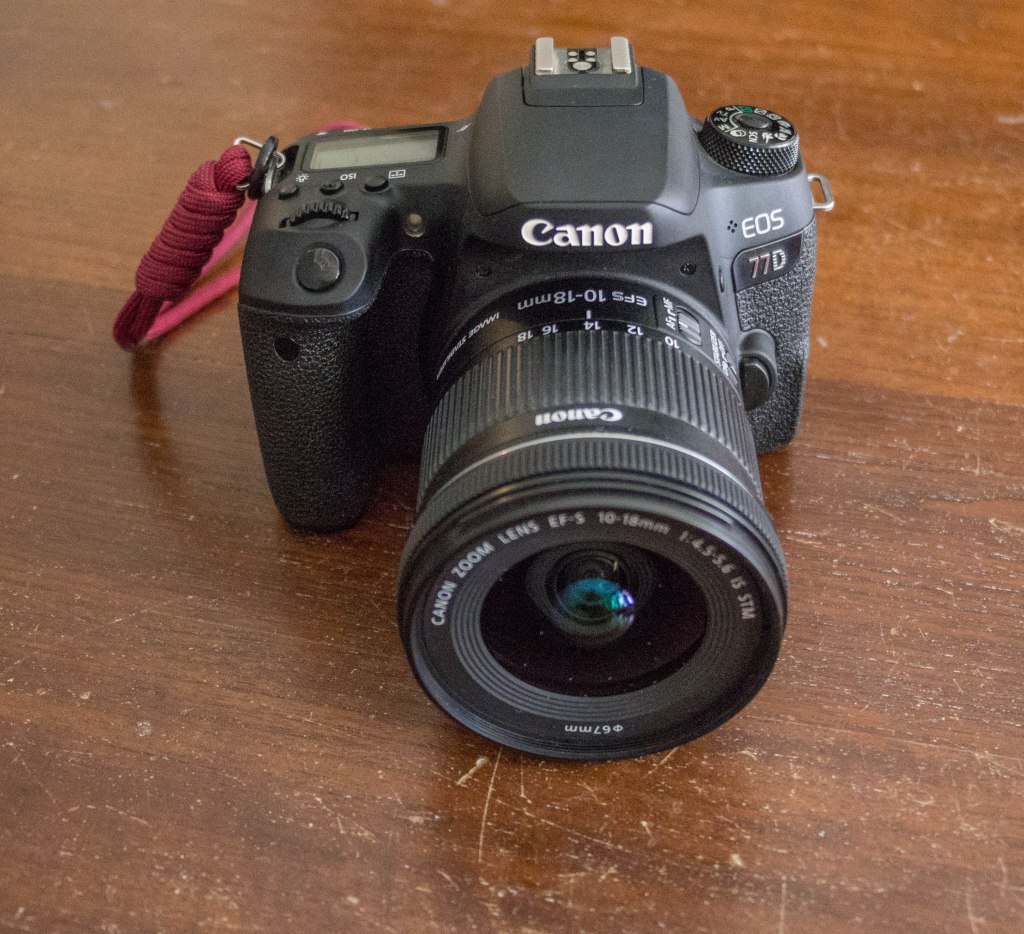
So after a year long fling with my M5 I have decided to return to DSLR world. With the Photographers option of the 80D, the Canon 77D, along with my Canon 10-18mm stm. So far loving it! after selling my mirrorless Efm lenses and researching what to buy as my M5 replacement. I feel as though I have made a good choice for my budget here. Got the camera and a 18-55mm stm kit lens (5K shutter count) for the price of my two efm lenses, 11-22 & 18-150. DSLR kit prices are falling fast here in Thailand as everyone jumps to mirrorless (although I have noticed a sharp increase in second hand sales there too),and I knew now was the time to “jump” back. Canon Eos M5 Mirrorless Camera and why I have changed back to DSLR Canon 77d, I expect people are wondering why I have moved back to DSLR, well here it goes….
M5 Like a lot
1. Size/weight
2. Smaller lighter lenses
3. Good external controls
Didn’t like…..
1. Small viewfinder, which is so close to the screen that no matter where you put your nose you end up touching the screen and moving your focus point. Also I felt that I could never see clearly, no matter the dioptre setting, maybe it’s just the whole EVF thing, for my eyes it was very hard work trying to see properly through it.
2. A fiddle to use the touch screen focus whilst looking through the viewfinder, which ended up with me having to move my eye away from the viewfinder –ergo, pointless VF
3. Grip on camera is very shallow and I never felt I had it comfortable in the hand and always felt like I was going to drop it.
4. Tilt screen not fully articulated (to be fair I thought this was not going to be a problem, but I found myself missing the fully articulated screen as on my 70D). It’s not until it’s gone that you miss it.
5. Battery life is poor even though I carry three batteries around and yes I have put it on Eco and all the other battery hungry options turned off. Actually I found that was quite a lot of the options that I would have liked to have that made that camera attractive in the first place.
6. Lack of selection of native lenses (Canon still have not produced a long zoom for this camera, instead forcing you back to the adaptor to use Efs lenses). Sigma and Tamron the same. Too few options of any decent quality lenses altogether, outside of the 18-150mm and 11-22mm. The decent lenses that are available are all primes and way off my budget. As a Landscape and travel photographer, I find the lack of UWA lenses frustrating (yes I know there is an adaptor, but again, it defeats the whole point of going smaller!)
7. Now the biggie… I never was happy with the “feel” of the images that came out from the M5. Yes they were nice and sharp and crisp. They just (to me) lacked character or depth? There is nothing wrong with them, I just didn’t like them and never felt happy with the finished product. I also felt that the colours were “watered down” and not what I was used to getting out of my previous Canon Cameras. Or maybe it’s the dynamic range?? Maybe it’s not the Camera, maybe it’s me, just I don’t feel that I have completely got on with the M5 as much as I thought or wanted to. I’m looking at the 77d photos I took last evening as testers, and I can see the dynamic range is better already.(yes I did have the settings right on the M5). The sky is the blue I remember seeing when I took the images and the colour of the water is bang on, with the 77d so far.
8. And a final word on the finish of the M5= poor, even within four months of me having it I noticed that the “rubber skin” just on the corner by the menu button had started to come away, on both edges. Also for some inexplicable reason a patch of rubber skin, just above the DOF button (which I never use) on the front has also “bubbled” or “peeled” and this isn’t even an area I touch for anything lol. The bottom plate of the camera scratches all too easily, even my 1100D plastic camera that travelled across SEA for a year didn’t look as bad. I don’t even put it down on anything other than tables either (M5).Don’t get me wrong the M5 is a great camera, just not for me. I guess to sum it up for me, the ergonomics are too small and fiddly, and the photo rendition output is not what I am used to (even after a year of experimenting with every setting under the sun). The build quality is poor, the battery sucks. The native lens options are limited and look like they are never going to expand. If I’m going to have to stick an efs lens on to get what I want in focus length, I might as well go back to the DSLR!
Canon 70d with Efs 18-135mm stmEfm 18-55mm stm on Eos M5
I’m not going to beat about the bush, and going straight to the point! I confess I am totally smitten with my 77d; I have been out and about more in the last week than the whole six months prior. I find myself wanting to go out and shoot and it’s been a whole new lease of life for me. Something I found I had lost with the M5.
The other thing I have noticed is how little PP I am having to do with the images from this camera, it’s such a liberating feeling, not spending hrs adjusting this and that to try and get the look I was expecting SOOC(or even as I saw it). Most images are basic lift dynamic range (not always needed as it’s so good), drop highlights, (which used to be a lot, and still didn’t reflect the skies how I saw them), and sometimes a straighten as I shoot mostly handheld. I also find the lens profiles do a great job in Lr5.7, and even better Lr5.7 has the profiles for my EFS lenses, so I don’t end up having to guess, or worse still having none!
I felt there was no depth to the images and colours were defo off. Gone was the Canon colour science, in fact I am inclined to think they removed it altogether, or moved it into a setting I could never find.
Now I get a better feeling of shape and space with these images. Interestingly there are other things I like about the camera as well, that I didn’t realise I missed until I got it back. For example; the shutter, I know it’s usually the Bain of my life especially when I am trying to photograph something discreetly, but the shutter button and sound is beautifully damped and has a reassuring feel to it that somehow helps me get my timing right.
Its weight is more than the M5, but actually marginally, I now realise how much the M5 felt heavy-ish in the hand, although the 77D will not beat it on small form factor, it is a fairly compact DSLR with full feature set or the 80D, minus the video crap! Which I don’t really do anyway so nothing lost there for me.
It’s a bit like I said to a friend recently when I got the 77D as an illustration. A few years ago, mobile phones were getting smaller and smaller and smaller, then people realised how damn uncomfortable they were and now we are pretty much settled at a decent sized smart phone, an era that I think will last for some time yet, and I predict will happen with the mirrorless camera revolution, and to some extent already is with the R series.
I also missed the fully articulated screen, the flip out up and down never really worked for me and I felt that I would actually have preferred a fixed one on the M5, for all the use it was.
Same battery lasts so much longer, if I turned everything useful off on the M5, I might squeeze a tad under 250 images before it died. Same battery on the 77D gives me about 350+ so far. The added bonus was I had bought two extra aftermarket ones for the M5 and they still fit the 77d!
I also like the top window on the 77d, and a much better and fewer options on it mean I am finding myself using it more often for changes on the fly. I.e. not having to take my eye away from the viewfinder, and knowing that one button is focus area/point and the other is ISO. The third is for the light lol, so the first two are totally practical. Along with the lock settings button (so many similarities with the 70D, makes it comfortable and familiar a lay out, making for less time wasted with settings) and a nice raised turn wheel for settings make this the joy to use this camera.
I especially like the on/off/video switch just under the mode dial. which also switches the video on. No accidently touching the video button with my right thumb as I hold the camera and starting a video, I have to use my other hand and deliberately push the switch round, so lessening “accidents”. There is a definite three point cllick as you switch through each option.
And lastly, but not least (ha-ha) the dioptre, so much better than the M5, I can see again, and although some say the pentaprism is slightly darker(I haven’t noticed)and the 77d has only 95% view, and the M5 coverage was 100%, I feel as though I see more on the 77d than the M5, if that makes sense?
I have to say that the Canon 10-18mm stm is a great pairing with this camera, the much lauded reviews about the 10-18mm stm are spot on. I am very pleased with how the two pieces of equipment work together. I love the edge to edge sharpness too. I also got the 18-135mm stm as it was such a versatile lens when I had it from new with my 70D.
It’s still a great lens, but found myself still missing the zoom end so have just bought myself a Tamron(long-time fan from my 10-24mm) 18-275mm PZD(which gives me a 28-440mm range on my 77d). I know super zooms like this have their limits and I am looking forward to testing it out. The main idea being that when travel eventually opens up again I only have to carry my 10-18mm attached to the 77D and the Tamron 18-270mm PZD in the bag. I am hoping that the image quality from the Tamron will be good enough so I don’t need to carry three lenses to cover my range of 10-300mm. Thus reducing my carry weight and still fitting into my copy peak design 5liter sling bag!
Please be aware that this is a two week update on how I’m getting on with the 77d.
Reviews on YouTube are all good and well but nothing beats real life user experience, right? I also appreciate people’s view on the M5 and how you might think I’m silly for going back to the 77d. So feel as though I should talk about why these differences are so wide in my view.
No regrets with the move back; in fact I am the happiest bunny on the planet for doing so. I am sure that if someone put a Canon RP in my hand with the right lens (that I didn’t have to sell my soul for), I would love it, and yes I could have bought a 6d, but I wouldn’t have had any money for the UWA lenses I like to use.
Also as a long time APSC girl, some habits die hard and this one is still alive and kicking. My view is Cameras are like people, different sorts of people go for different sorts of camera, there’s nothing wrong with any given camera; just some get on with some more than others. Some people have many cameras; some have many different brands of cameras. I think this is what happened to me, tried a new type and really didn’t like it. Bit like a bad boyfriend/girlfriend, thought it was ok, then found out I couldn’t live with its faults, affair well and truly over! Looks like I’m a DSLR camera girl that knows what she likes.
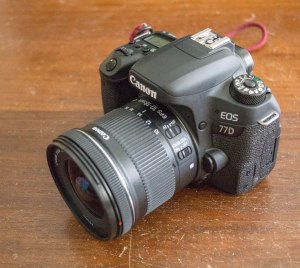
Canon 77D with canon 10-18mm stm
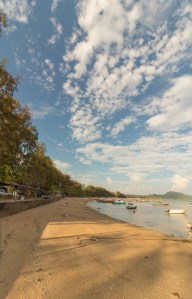
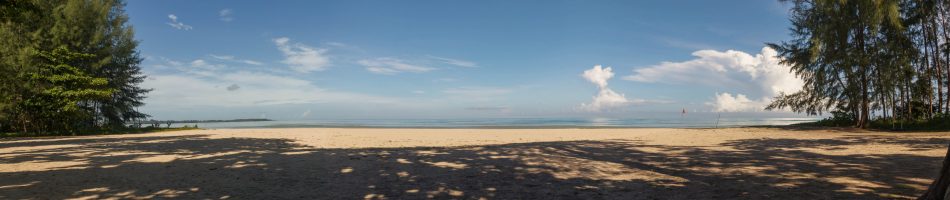
Image of Rawai Beach taken on my first day with this Camera, with the Canon 10-18mm stm
Thankfully not everything was closed or locked down over December 2020, here in Phuket. I was able to get around and spend some time visiting some of the places I had promised myself to go. Here The Tha Rua Shrine, which cannot be missed as any traveller arriving or departing Phuket will pass it on the way out or to Phuket Airport.Along side a busy road, this Temple has caught my eye so many times, i was so glad i stopped to give it a look. I was not disappointed!
One of Phuket’s largest and most elaborate Chinese temples, the Tha Rua Shrine is also one of the most colourful, adorned with numerous brightly painted statues of dragons and deities.
The Tha Rua shrine is one of the oldest Taoist foundations on Phuket, although the site has been greatly expanded and the present building dates from 2002.
Located in the Thalang district, north of Phuket Town, the Tha Rua Shrine is an easy excursion for those visiting the island. It’s certainly an unmissable and arresting sight, with its bright gold, red and green colour scheme and its outsized statues of mythical creatures and Taoist divinities.
Visitors are greeted at the entrance by a pair of multicoloured Chinese dragons, while inside devotees burn incense and offer prayers in front of statues of Quan Yin, the goddess of mercy, and altars covered in statuettes of various gods.
The Tha Rua Shrine is a popular and busy temple and visitors are welcome to explore the complex throughout the day. To avoid the crowds, it’s best to visit in the early morning.
It’s a great place to take photographs, too. Statues, traditional Chinese paintings and carvings fill the interior and cover the façade, while outside stands a giant statue of Guan Yu, a revered Chinese general from the second century AD who was deified after his death.
I’ve never been to Patong beach in the whole two years i have lived here. Expecting the worst of heaving numbers of people during what is now high season. Imagine it like this, today, peak season, with only a few people here……
Patong Beach, or Hat Patong as it is called in Thai, is the main beach in Patong and is a wide 2,85 km long stretch of white soft sand. Patong’s 3-km strip of golden sand is one of the most popular beaches in Phuket. The Beach has a row of coconut, palm and tropical almond trees separating the shore from the main road.
The northern part of Patong Beach hides a small sandy creek where the water is very shallow and clear during high season. The southern part is the mouth of a river, where several fishing boats anchor. The bridge over the river leads to a small fishing village and the various bays and beaches around the headland that separates Patong from Karon.
The best time to visit Patong Beach in Phuket is between November and April when the sea is very flat and calm. From May to October, the beach experiences large waves and dangerous swells.
There are two small beaches in this bay south of Cape Panwa on the east coast of Phuket, separated by rocky headlands. It is about 10 kms from town and easily accessible by car and motorcycle. The road from Ban Bo Rare which takes you to Ao Yon is attractive and full of shady trees.
The bay is tranquil, the sea is very blue, and the sunset here is also magnificent. Tourists like to relax by sitting under the coconut palms watching waves twinkling in the sunlight.
Travelling to Ao Yon Bay There are two routes to this beach. From town, follow the road to Panwa Beach. There is a small soi to take you to Ao Yon pass Bor Rae Village. This road offers a nice scenery of beaches and a view point. The other route to Ao Yon is from Panwa Beach and Makam Bay. Follow the Ao Yon Khao Khad Road to the beach. This route is shorter than the other one.
Paradise beach bar and restaurant is located Rawai Phuket Thailand.
It is not that which is the focus of this video though, more a point where I started a beautiful walk along what at first appeared to be a very small part of rawai Beach, but as the tide went out during the morning gave me access to other more secluded parts of the beach, which curves round towards the cape of Panwa.
Sometimes time is better spent waiting for better moments to present themselves to you.
 Canon 70d with Efs 18-135mm stm
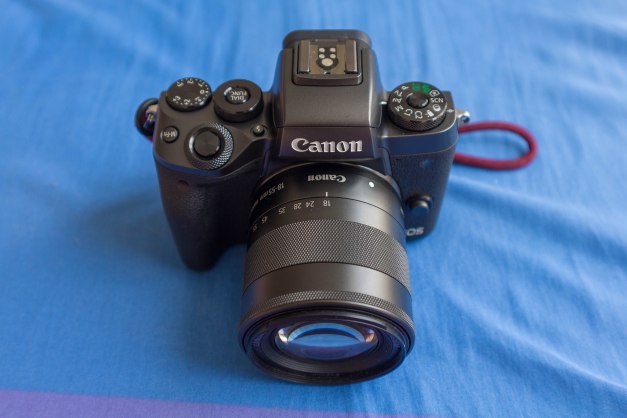 Efm 18-55mm stm on Eos M5