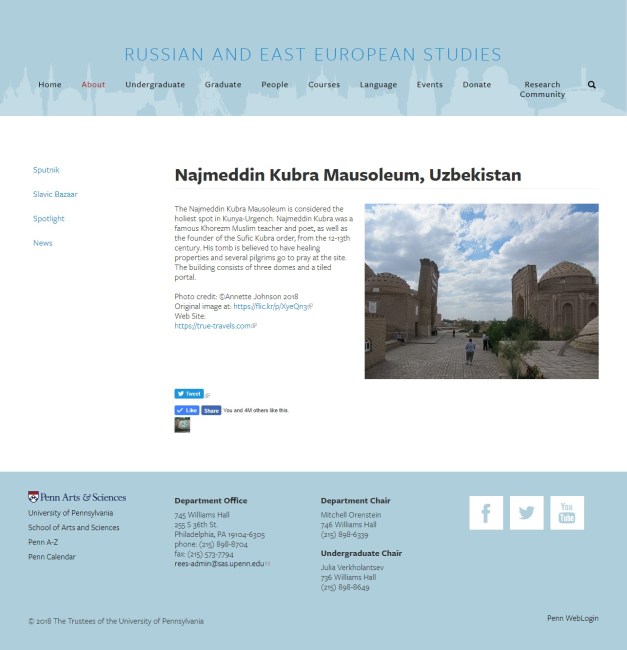
This article from the series of “Spotlights” for the department of Russian and East European Studies at The University of Pennsylvania is a look at The Najmeddin Kubra Mausoleum, which I visited myself on my “Silk route Journey” in 2012. It was one of the many historical sites I visited during my time in Uzbekistan.
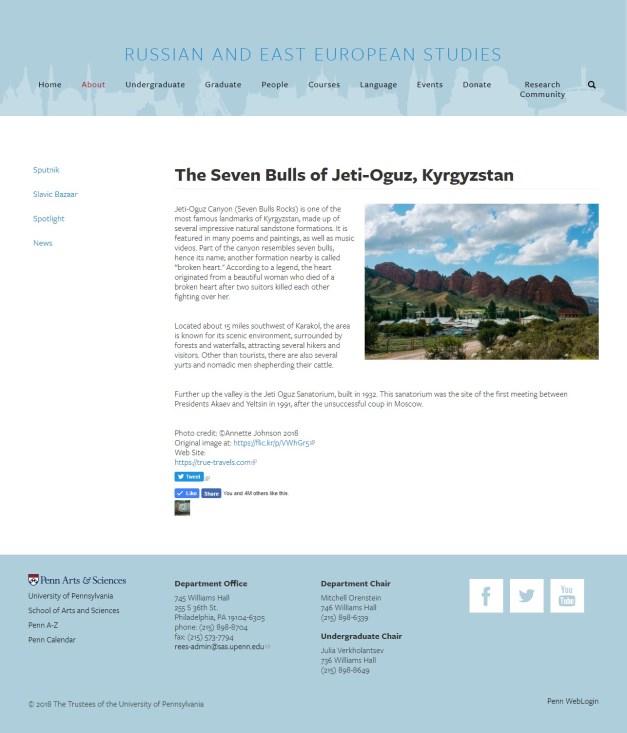
This article from the series of “Spotlights” for the department of Russian and East European Studies at The University of Pennsylvania shows us the beautiful and stunning colour and shape of the Jeti-Oguz Canyon known as the; Seven Bulls Rocks.
This next article from the series of “Spotlights” for the department of Russian and East European Studies at The University of Pennsylvania takes a look at The Independence Monument in Tashkent’s Independence square in the city centre.
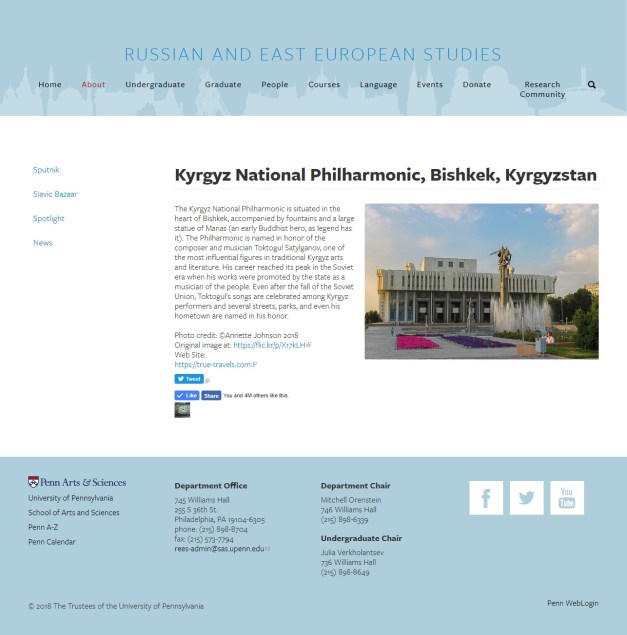
This next article from the series of “Spotlights” for the department of Russian and East European Studies at The University of Pennsylvania focusses on the The Kyrgyz National Philharmonic Building, which is situated in the heart of Bishkek.
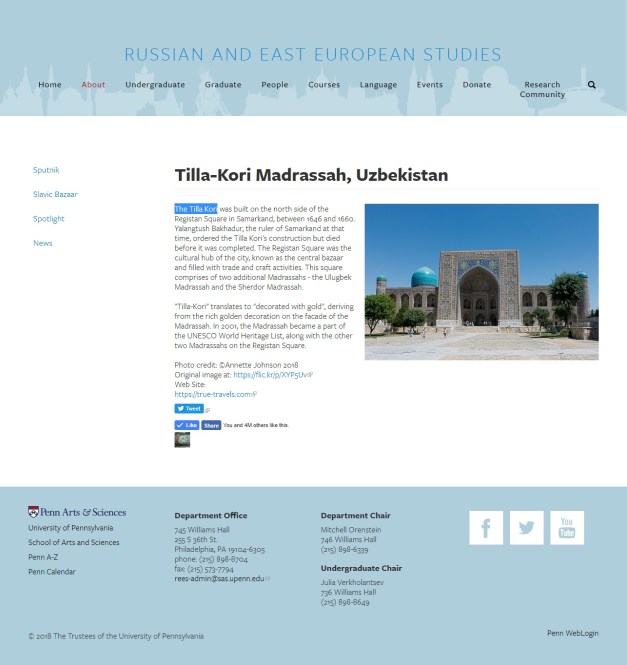
Next in the series of “Spotlights” for the department of Russian and East European Studies at The University of Pennsylvania is the The Tilla Kori Maddrassah in the Registan complex in Samarkand, Uzbekistan.
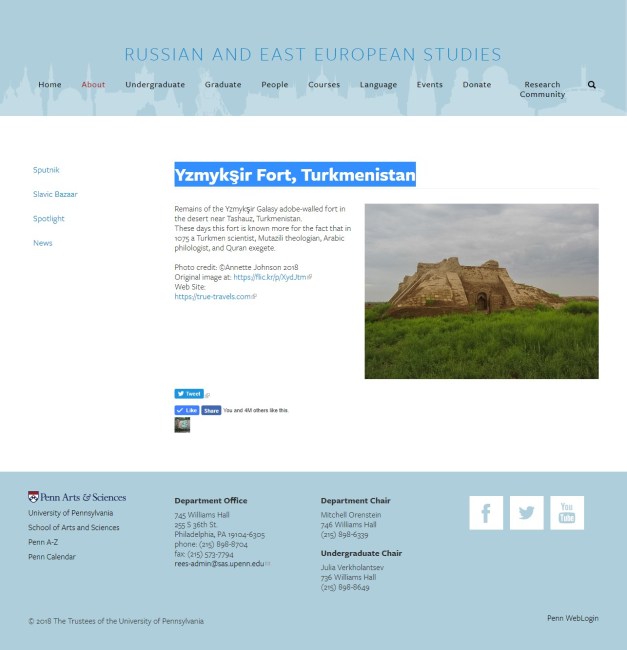
So the second in a series of Spotlights from the University of Pennsylvania, this one focusses on Yzmykşir Fort.
The Yzmukshir Fortress, with its unique double wall fortifications, thrived in Parthian times, under various Turkic rulers, and during the Golden Horde, as an important regional trade and craft center in Khorezm.
The gates, towers, enormous moat and well-preserved 25-meter high walls that stretch for some 1500 m, remain an impressive sight. Next to the fortress is a mausoleum, allegedly of a famous medieval philosopher Abu az-Zamakhshari, and therefore Yzmukshir is also known as Zamakshar
Below are some of the other images I took when I went to Yzmukshir fort in 2012 as you can see there are no complete structures and the desert is taking its toll.
Wang Matcha Restaurant – Nakhon Ratchasima- Thailand
Wang Matcha* Restaurant is in Korat city about four km from the city centre, Korat. I don’t usually write about wining and dining but this is one place you will want to write home about and share with your friends. I haven’t come across a restaurant like this in Thailand.
*wang – palace, matcha – fish
Matchachat – Pisces, the 12th sign of the zodiac
Matchanu – the son of Hanuman the monkey god and a female mermaid, Suvannamatcha in Ramakien, the Thai version of the Ramayana epic
The layout of the restaurant
Wang Matcha Restaurant consists of a huge lake about 150 m x 100 m with pavilions all round the lake that serve as dining rooms. The main restaurant building, where the kitchen is located, has both indoor and outdoor dining facilities.
The small pavilions around the lake are suitable for small groups of friends who would like some privacy and to be away from the crowd.
The whole place has a natural ambience with lots of trees, plants and garden lighting. There’s a windmill in the middle of the lake that’s lit up at night. Plus a pavilion of live music!
The distance of the pavilion at the southern corner of the lake to the kitchen in the main building is about 150 m. How then are diners going to get their food in time?
Simple, food is delivered by speed boats racing across the lake.
Thank you so much for choosing my “Dahlia” Heather, the detail is beyond excellent! And for allowing me to showcase it here on my web site.
Today’s stunning piece of work comes from Heather Bergquist who works in the medium of Pyrography. Now I wasn’t sure about what or how that exactly works so for those of you who are wondering it’s ; “the art or technique of decorating wood or leather by burning a design on the surface with a heated metallic point.”
When I asked Heather about it she said, she uses an electronic Razertip Pyrography burning system which consists of a rheostat base and pens that attach with cords. and used several different shading pens for this piece.
I was approached by a member of staff from from University of Pennsylvania, department of Russian and East European Studies. She kindly asked me if they could use my photo on one of their pages under the rubrique of “Spotlights”. They make one “Spotlight” page per one interesting location or a sight in Eastern Europe and Eurasia. It is purely to show our site visitors that there are tons of cool places to explore in that part of the world, on their department University web site
I was delighted and I would like people to access it as much as possible so they can share this part of my epic journey.
During my visit to Myanmar in 2015 after the famous Bagan, we journeyed by train to Kalaw. A beautifully cool hill station town, with it’s own cool caves at Shwe Oo Min Paya.
The cave system here is full of many golden Buddha’s, mostly donated by visiting pilgrims from all over the world, and there are some 8,700 of them festooning the cave interiors according to Lonely Planet’s 2011 Guide to Myanmar, (The oldest date back about 275 years.)
It’s an extensive complex, with small meditation caves still used by monks, and there are stalactites with water dripping away which add to the atmosphere. A splendid 40′ sitting Buddha was found in another cave pavilion reached by a covered walkway. A real highlight of any visit to Burma.
Having stayed twice now at this most most Unique and funky, not to forget Arty, hotel. I would be remiss in not sharing the interior for you to see.
The last time I stayed in this Hotel , before this occasion was back in 2008 on my Honeymoon, those were the days of well paid employment and being able to treat yourself without feeling guilty.
On this very recent stay it was once again on the Anniversary of my Wedding, times have changed and I could not have even considered this if my significant other had not spotted it for a much lower than usual price in one of their promotions. Spoil again? Why not. Know perhaps that I may either never be able to afford this Hotel for some considerable time, or just may want to stay somewhere else, I decided to photograph everything that I loved about this wonderful work of Art!
‘Unique’ is possible the most overused word in hotel marketing. So much so in fact, one might be tempted to question translation proficiency within the ranks of the Bangkok hospitality industry. Siam@S ram is one property that shies away from such grandiose claims however, subtly allowing guests to appreciate the hotel’s distinction qualities without screaming it from the elegant rooftop terrace.
The hotel itself may hate graced Rama I opposite the National Stadium for the past seven years, the Phornprapha family behind the propel’ has owned the land for decades. In fact, the very land the boutique hotel stands on was once the head office of the family’s successful motor business. is a homage to the family’s history, local artists were contracted to infuse the hotel with industrial elements that created the familv’s fortune. From the moment one vis through the front doors, it’s plain to see that the talented artists have developed the concept with panache, leaving you in no doubt that this is anything but an average hotel. Borrowing inspiration from fairytale, each door of the 25-storev property marries an elegant combination of dark, sultry red tones with earthly, vibrant woods and artistic façades. Indeed, artistic consideration has been delievered with enthusiasm at every turn.
From exposed wooden beams within the welcoming, comfortable bedrooms to the elegant menus at flagship French restaurant La rue (which contain carefully considered poetry, hand-drawn illustrations and dish descriptions from Executive Chef Gilles Poitmin that inform and enlighten), the hotel’s purpose is as layered as the deep artistic ethos.
It’s this attention to detail that demonstrates the passion that went into creating Bangkok’s first art concept hotel, even before the word ‘boutique’ made it’s invasive appearance and became the buzz word for 21st century hospitality
In early 2015 I pent three weeks in Myanmar. One of my favourite places was the ancient city of Bagan.
Here you can see the Lawkananda Pagoda and it’s beautiful outbuildings. The Lawkananda Paya is a beautiful golden pagoda on top of a small hill on the banks of the Irrawaddy river. Its name translates to “Joy of the world” in ancient Pali language.
The pagoda, also known as the Loka Nanda pagoda was built in 1059 by King Anawrahta, founder of the Bagan empire. It enshrines a replica of a tooth relic of the Gautama Buddha, that the King obtained from Sri Lanka.
The pagoda, located a few kilometers South of old Bagan marked the Southern boundary of Bagan’s capital. The cylindrical pagoda somewhat resembles the much older Bupaya pagoda, located further North in old Bagan, which is more bell shaped. From the Loka Nanda’s platform visitors have good views of the Irrawaddy river and the mountain range in the background.
At night the pagoda is lit up. Although an attractive place with the river breeze and serene atmosphere, the Lawkananda is a little visited Paya, mainly used by Burmese people as a place of worship. In the middle of the rainy season late July, Early August depending on the lunar calender the Lawkananda pagoda festival is held to celebrate the rain in the very dry Bagan region