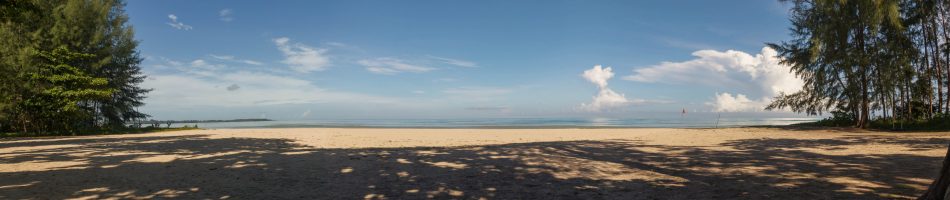
Sanur Beach has a lengthy shoreline (about 7 kilometers) with a paved footpath that runs the length of it, making it ideal for an early morning walk, jog, or bike ride. Which is exactly what I did when i took these photos during my walk.
It’s a beautiful course flanked by fishing boats, hotel gardens, and beach eateries, with views of Mount Agung volcano in the background on occasion.
Although it was shrouded in heavy mist during my visit, so I really didn’t get to see it at all. But as you will see from my photos the weather at the beach was stunning with a beautiful cool breeze, and lots of lovely small cafes and restaurants to stop and refresh at along the way.
Padang Galak Beach is Sanur’s northernmost beach, where experienced surfers can enjoy strong waves most of the year.
It has a narrow shoreline with concrete wave breakers adjoining a beach footpath. The area enjoys strong winds (10–20 knots) from June to August, making it a popular spot for Bali’s traditional flying hobbyists.
Also known as the black beach, on account of it’s black volcanic sand. A truly bracing but wonderfully free-ing place to be. Padang Galak Beach hosts the annual Bali International Kite Festival, usually in July or August, depending on weather conditions. Hundreds of competing kite troupes gather from all over the island to pilot their traditional kites at a spacious grassy beachfront field. The troupes often compete against international teams flying modern kites of various shapes and sizes.
We were too early in August for this event, but saw lots of kites all around The beaches on the Sanur coastline
Duyung Beach is located not far from Sanur Beach and is actually part of the same coastline. You can even find a pedestrian path that connects the two beaches, with just a 5-minute walk between them.
Duyung Beach is quieter and less crowded, making it suitable for those who want to enjoy a relaxing time at the beach. The peaceful atmosphere makes it an ideal spot for families with children to play in the sand and swim in the calm waters.
Moreover, Duyung Beach is a great location for photography enthusiasts as many fishing boats often dock along the shore, providing a unique charm. Plus, water sport of Paragliding. I got some beautiful Photos of the seascape and hope you enjoy them too!
It took 28 years to build this massive statue of the Hindu god Vishnu riding a mythical bird.
It is the tallest statue in Indonesia, the world’s tallest statue of a Hindu deity, and if you include its massive base. If you include the huge base on which the statue stands, its total height of 397 feet (121 meters) ranks it as the fourth tallest statue in the world. The entire structure was built from 754 modules, pieced together to form a gargantuan statue weighing more than 3,000 tons, with a steel frame covered in a copper and brass skin.
On top of Vishnu’s head sits a 3.5-ton crown covered with gold-plated mosaics. This is set in an area of 60 hectares, and houses some other very large statues, such as the Garuda’s head, and Vishnu and the dancing Garuda.
I Hope you enjoy this journey round the park with me!
One of the less visited places, it does not make it less at all. The walk there through the Indonesian countryside made it not just beautiful, but insightful into rural Indonesia. We were the only people there and loved it. Especially catching the boys flying their kites in the fields.
Yeh Pulu Temple located at the Bedulu Village nearby Ubud. Inside the temple, you will find a wall that stretched along 25 meters with beautiful reliefs telling about the ancient Balinese’ life. There is also a cave in the area, believed as the meditation place of King Bedahulu at 1343. Therefore, it’s not strictly a temple, more like an archeological site, which does not make it a less interesting site to visit.
The Balinese still come to worship the Ganesha Statue, that’s why probably people call it a temple these days or in Indonesian: Pura Yeh Pulu. The name of this temple was derived from two words Yeh means water and Pulu means as a container used as a place to keep the rice for locals.
That is why we can find an actual container in a shaped like a barrel at the spring of holy water. During full moon or the anniversary of the temple, many worshippers from near villages come for praying.
The Goa Gajah Temple is also nearby, therefore it’s very convenient to visit also Goa Gaja. Both are impressive and give you a deeper insight into the culture and traditions of Bali.
Whilst in Ubud, I had planned beforehand to visit the Masks and Puppets Museum, always being fascinated by puppets as a child and into my adulthood, you can image the thrill and pleasure I got from this visit!
EXHIBITIONS SPACES The collections of the House of Masks and Puppets are housed in four different traditional Javanese antique houses or commonly known as Joglo. These unique Joglos are mostly originated from East and Middle Java. They are made out of good quality teak wood and have been put up to help keep their preservation. All the exhibits are displayed and curated in English as well as Balinese.
The collection of the House of Masks and Puppets currently consists of approximately 7000 items, of which 1300 are masks from Indonesia, Africa, and Japan; whilst the other 5700 are puppets from Indonesia, China, Malaysia, Thailand, Myanmar, and Cambodia. Although the House of Masks and Puppets has several objects from other countries, the collection mostly consists of items from various regions in Indonesia. The acquisition of various masks and puppets from other countries is intended for additional learning, appreciation, and understanding of other cultures.
I have split the collection as in their displays in four houses. From full human sized costumes and masks, to face only masks, to shadow and screen puppets and finally wooden puppets!
Whilst in Ubud, I had planned beforehand to visit the Masks and Puppets Museum, always being fascinated by puppets as a child and into my adulthood, you can image the thrill and pleasure I got from this visit!
EXHIBITIONS SPACES The collections of the House of Masks and Puppets are housed in four different traditional Javanese antique houses or commonly known as Joglo. These unique Joglos are mostly originated from East and Middle Java. They are made out of good quality teak wood and have been put up to help keep their preservation. All the exhibits are displayed and curated in English as well as Balinese.
The collection of the House of Masks and Puppets currently consists of approximately 7000 items, of which 1300 are masks from Indonesia, Africa, and Japan; whilst the other 5700 are puppets from Indonesia, China, Malaysia, Thailand, Myanmar, and Cambodia. Although the House of Masks and Puppets has several objects from other countries, the collection mostly consists of items from various regions in Indonesia. The acquisition of various masks and puppets from other countries is intended for additional learning, appreciation, and understanding of other cultures.
I have split the collection as in their displays in four houses. From full human sized costumes and masks, to face only masks, to shadow and screen puppets and finally wooden puppets!
Whilst in Ubud, I had planned beforehand to visit the Masks and Puppets Museum, always being fascinated by puppets as a child and into my adulthood, you can image the thrill and pleasure I got from this visit!
EXHIBITIONS SPACES The collections of the House of Masks and Puppets are housed in four different traditional Javanese antique houses or commonly known as Joglo. These unique Joglos are mostly originated from East and Middle Java. They are made out of good quality teak wood and have been put up to help keep their preservation. All the exhibits are displayed and curated in English as well as Balinese.
The collection of the House of Masks and Puppets currently consists of approximately 7000 items, of which 1300 are masks from Indonesia, Africa, and Japan; whilst the other 5700 are puppets from Indonesia, China, Malaysia, Thailand, Myanmar, and Cambodia. Although the House of Masks and Puppets has several objects from other countries, the collection mostly consists of items from various regions in Indonesia. The acquisition of various masks and puppets from other countries is intended for additional learning, appreciation, and understanding of other cultures.
I have split the collection as in their displays in four houses. From full human sized costumes and masks, to face only masks, to shadow and screen puppets and finally wooden puppets!
Whilst in Ubud, I had planned beforehand to visit the Masks and Puppets Museum, always being fascinated by puppets as a child and into my adulthood, you can image the thrill and pleasure I got from this visit!
EXHIBITIONS SPACES The collections of the House of Masks and Puppets are housed in four different traditional Javanese antique houses or commonly known as Joglo. These unique Joglos are mostly originated from East and Middle Java. They are made out of good quality teak wood and have been put up to help keep their preservation. All the exhibits are displayed and curated in English as well as Balinese.
The collection of the House of Masks and Puppets currently consists of approximately 7000 items, of which 1300 are masks from Indonesia, Africa, and Japan; whilst the other 5700 are puppets from Indonesia, China, Malaysia, Thailand, Myanmar, and Cambodia. Although the House of Masks and Puppets has several objects from other countries, the collection mostly consists of items from various regions in Indonesia. The acquisition of various masks and puppets from other countries is intended for additional learning, appreciation, and understanding of other cultures.
I have split the collection as in their displays in four houses. From full human sized costumes and masks, to face only masks, to shadow and screen puppets and finally wooden puppets!
Whilst at the GWK Park I was able to attend a performance of Balinese dance. In three main chapters, this is no.3 of the three. I considered them to long to put together for YouTube purposes. I hope you enjoy.
Below is some information about Balinese dancing;
Balinese dance is a variety of dances originating from the island of Bali. Balinese dance does not always depend on the storyline. The main goal of Balinese dancers is to dance each stage of movement and sequence with full expression. The beauty of Balinese dance can be seen in the abstract and beautiful movements. The most famous Balinese dances include Pendet, Gambuh, Baris, Sanghyang and Legong.
Balinese dances are mostly religious in meaning. Since the 1950s, with the rapid development of tourism, several dances have been performed at activities outside of religious events with some modifications.
Balinese dance is one of the attractions of tourists to come to this island of the gods. In this video, the Balinese dance in GWK shows a dance that we took pictures of at a tourist spot known as Garuda Wisnu Kencana or GWK.
Whilst at the GWK Park I was able to attend a performance of Balinese dance. In three main chapters, this is no.2 of the three. I considered them to long to put together for YouTube purposes. I hope you enjoy.
Below is some information about Balinese dancing;
Balinese dance is a variety of dances originating from the island of Bali. Balinese dance does not always depend on the storyline. The main goal of Balinese dancers is to dance each stage of movement and sequence with full expression. The beauty of Balinese dance can be seen in the abstract and beautiful movements. The most famous Balinese dances include Pendet, Gambuh, Baris, Sanghyang and Legong.
Balinese dances are mostly religious in meaning. Since the 1950s, with the rapid development of tourism, several dances have been performed at activities outside of religious events with some modifications.
Balinese dance is one of the attractions of tourists to come to this island of the gods. In this video, the Balinese dance in GWK shows a dance that we took pictures of at a tourist spot known as Garuda Wisnu Kencana or GWK.
Whilst at the GWK Park I was able to attend a performance of Balinese dance. In three main chapters, this is no.1 of the three. I considered them to long to put together for YouTube purposes. I hope you enjoy.
Below is some information about Balinese dancing;
Balinese dance is a variety of dances originating from the island of Bali. Balinese dance does not always depend on the storyline. The main goal of Balinese dancers is to dance each stage of movement and sequence with full expression. The beauty of Balinese dance can be seen in the abstract and beautiful movements. The most famous Balinese dances include Pendet, Gambuh, Baris, Sanghyang and Legong.
Balinese dances are mostly religious in meaning. Since the 1950s, with the rapid development of tourism, several dances have been performed at activities outside of religious events with some modifications.
Balinese dance is one of the attractions of tourists to come to this island of the gods. In this video, the Balinese dance in GWK shows a dance that we took pictures of at a tourist spot known as Garuda Wisnu Kencana or GWK.


 Journeys From A Small Room