About forty minutes north of Yazd is Meybod. Like Yazd, it is also a desert city and much of its buildings are made from mud-brick. We visited the Narin Qal’eh (Narin Castle), a mud-brick fort which incorporates mud-bricks from various periods from Sassanid, Achaemenid to Islamic. From the top, it provided us a view of the town of Meybod.
Islamic Republic of Iran
Shah Abbasi Caravansary is a road side inn, located in Meybod, Yazd. Caravanserai’s supported the flow of commerce, information, and people across the network of trade routes covering Asia, North Africa, and south-eastern Europe, especially along the Silk Road. Caravansary Complex of Meybod, House of Courier or Post Museum and Ice house remind the importance of this city in the past. Constructing these buildings was a great help to get on life in the harsh situations of the desert.
It is one of the important Safavid period Caravanserais. It is very important in case of architecture, placing and interior design. It is based on a rectangular plan with a yard – Centered design. It is made of brick with four veranda method. The building is made up of covered passageways, exterior verandas, vestibule, central yard and one hundred rooms. The yard has 24 chambers that today are used as handicraft workshops or handicraft shops.
Located close to Meybod’s Safavid Shah Abbasi Caravansary, the Ice House is a mud brick structure consisting of an ice pool, tank and a yellow-coloured conical dome. The Ice House is one of the traditional structures that enabled human adaptation to desert life.
It is known to be the most sacred of sites for Zoroastrians. Chak Chak is literally built on a mountain cliff in the middle of the desert. The name ‘Chak Chak’ is the Persian word for ‘drip drip’ due to the ever-dripping spring located at the mountain.
The main attraction is the Zoroastrian temple guarded by two bronze doors on top of the cliff. Inside is a fire which burns eternally. Each year thousands of Zoroastrians visit this temple from June fourteen to eighteen. Tradition requires that on approaching Chak Chak, when pilgrims see the temple, they must walk the remaining distance.
The road out to Chak Chak takes you through some of the most delightful scenery I have seen so far in Iran. One road in particular stretched into the distance for what seemed like forever until it ran into the base of the mountains.
The story goes that Nikbanou, second daughter of the last Persian ruler, Yazdegerd III of the Sassanid Empire, fled here under attack by an Arab army in 640 CE.
Nikbanou, the young woman who fled to this area to escape an Arab army, prayed to Ahura Mazda, creator and only God in the Zoroastrian religion. Long story short, Chak Chak now serves as a pilgrimage point for pious Zoroastrians. Each year for 4 days in June, thousands of Zoroastrians from all over the world, flock to Chak Chak. Tradition has it that pilgrims are to stop riding the moment they catch sight of the temple and complete the last leg of their journey on foot.
Kashan
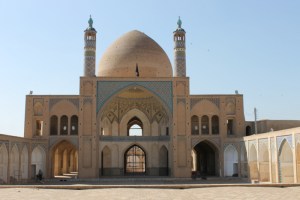
Kashan is much smaller than Tehran; we arrived by bus about 3.00pm. We managed to get a taxi to near enough the Noghli home stay. As with some Iranian taxi drivers, they say they know the way, but are not really sure! Sometimes, they try and ask you for more money than was agreed. Taxis the world over seem to be like this.
Finally we arrive at Noghli, it appears that there are no rooms left, but they do manage to find us one twin for one night, and then we have to swap night two for a single room and one of us sleeps on the floor.
A Traditional home, the owner allows women not to have to wear their scarves all the time, a welcome relief. Local food is served (at extra cost), and very nicely put together in an arch underneath the first floor on a long table, in front of the courtyard.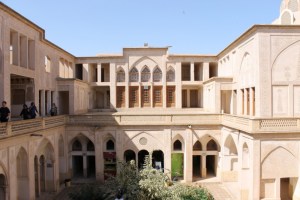
Next day we walk to the ancient merchant houses and hammam, all very cheap to get into and easy to find once you’re on the main street. We spent most of the day walking round these, yes we do things slowly.
We also visited finn Gardens which are supposed to be the finest examples of Persian gardens. It was a bit like going to wisely on a bank holiday, it was heaving, so perhaps we didn’t enjoy that one as much as we could have.
Basically that was it for Kashan, it really isn’t a big place and actually if you were of the mind you could do it passing through to Esfahan.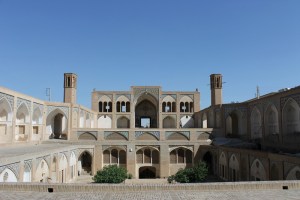
Esfahan
Beautiful Esfahan, I don’t think anywhere else in Iran will come close for me as Esfahan. You cannot fail to be wowed by the imam square. With two mosques and a palace and portal gate leading to the Bazaar. Yes it is huge, we got to look at it on our first evening and got some lovely pics of everything all lit up and the fountains spraying lovely cool water. The square was full of Iranians and their picnics and ice cream parlours like a Sunday afternoon in England, browsing the numerous stalls that line all sides of the square.
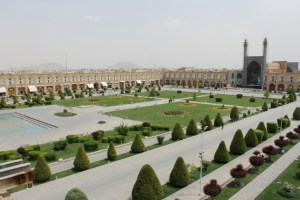
Next day we sorted out Laundry (approx £7 well we did have a little lot and we got done a little). We got our Iran cell sim card sorted(cost. us 7000rial) After that we had to go and do a bit of bag shopping as my backpack developed a small but significant tear in the side and I didn’t fancy having all my pants exploding out in some Iranian street anytime soon! After some searching I found a great bag stall down an alley on the way to the square by the money lenders and shoes shops, I couldn’t believe the price, I paid out the equivalent of £23, I had paid some £55-65 five years ago for my backpack from Blacks! This is like a wheelie bag, but better, it also changes into a Backpack when needed, and access is better through the top. We arranged to pick I up on the way back to the hotel as all shops seem to stay open until 10.00pm.
We had time to grab some lunch from a great “Hole in the wall” eatery as we call them, just outside the entrance to the square. Then set off for the Kilpaka Palace in the square. Well six flights of stairs later and you are greeted by an amazing view of the square. Unfortunately, but necessary was some restoration work being done to the outside of the upper level of the palace, along with the adjacent mosque. The Music room on the upper floor is definitely worth the climb, a method of managing acoustics that would look divine in any concert hall!
We visited a few of the mosques mentioned in the LP and some that were not! All were very cheap to get into. You must not and cannot go to Esfahan without visiting the Bridges of Esfahan of which there are 11, some you can walk on and around and others are more road bridge than people bridge. Many Iranians of Esfahan walk and visit these great bridges and there are easy and beautiful paths and gardens along the river walk.


Iran
What can I say….
The welcome and hospitality of the people is immense. As two women travellers we never felt in danger. People were always greeting you with the ubiquitous three questions; “How are you?” “Where are you from?” and “What do you think of Iran/Iranian people?” Some with better English will ask “where are you going?” and “where is your favourite place in Iran?” In particular the public transport staff was always keen to make sure we were on the right bus /train and that we got off in the right place once we reached our destination (i.e. Terminals). They always made sure we had refreshments and knew when to get off for toilet breaks (buses) and always helped us with our baggage. A special mention goes to the staffs at Tehran who were overwhelmingly helpful when we purchased our bus tickets, even showing us personally to the bus and into our seats. Another highlight was on the bus from Kashan to Esfahan, where the driver and other staff shared their morning tea with us and asked us to sit in the front seats so we had more space. This helpfulness extended to the train staff as well. The train driver from Kerman to Yazd came and introduced himself to us (Jafra was his name) at the train station terminal whilst we were waiting, and spoke excellent English, he was so pleased that we had come to visit Iran, and again made sure that we were comfortable in our seats before setting off to drive the train to Yazd! Every time the train stopped, he came to find us and explained the delay and finally when we got to Yazd he explained to the local taxi driver where we wanted to go (though the driver still got it wrong, but that’s another story)! Iranians have a healthy curiosity about visitors, but it is never intrusive – what is wrong with that?
Yes some small Shops will hike the price of cold cans of drinks up when they see you, but when you go again they ask the right price, and let’s face it; it is not exactly expensive in the first place.
As western women we found that a reasonable tolerance was given to our dress. We did try at all times to respect the dress code required of women in Iran, we always wore our headscarves at all times, which is a pain, more so when you are trying to go to the toilet, or we found most cumbersome when eating a meal. I bought a further scarf in Shiraz which was super thin and lightweight and cost a mere £1.70, and felt like I wasn’t wearing a scarf at all. Even better than wearing our heavier ones we had bought in Turkey. We did get along with wearing long sleeved long shirts/blouses and our long lightweight coats, which we had purchased for this trip, remained for the whole in the bags- to be posted home when we got the chance. Esfahan was very liberal, I think because they do get so many more foreign tourists than other towns, and shirts that remained long sleeved but just past the bottom were acceptable.
When we visited the shrine of the King of Light in Shiraz, we did have to wear a chador, which was given to us on arrival. I had to put my Camera in a secure cloakroom, and after removing battery and sd card I duly handed over. We were as two women welcomed into the shrine (we were surprised) and allowed into the holy areas that house stunning mirror interior decoration throughout, along with welcome air con. The women showed us where to put our shoes and where the shrine was and welcomed us. As I commented to my Angela, if you “get with the programme, you get the benefits”. It may not be comfortable and it may challenge you moral values as a woman, but if you want to see Iran as a woman, you will have to comply a bit. The benefits outweigh the discomfort.
On the whole we were treated with the utmost respect as foreign travellers and the Iranian people were so pleased to see us. Did I mention the Iranians are the kings of picnics, well they are! Where they have parks or open plazas Iranians gather with and without their families to have picnics, they bring everything, even the burner stove to heat up their tea! You will see them all carrying large bags and blankets, and cool box with some yummy Iranian foods in, don’t be surprised or afraid if you are asked to join them as you pass for a cup of tea, they just want to be friendly.
Btw my camera was returned safely back to me, as always we have found so far here, crime did not seem a big thing, on the whole Iranian people are pretty honest too. Sometimes again a teahouse would hike an extra 40p onto the bill,(touristy places recommended by LP) but to be honest we did not bother arguing as again experience and impression were more important to us than penny pinching to that degree.
Even in Kerman, when we secured a driver through our fabulous hotel, Akhaven, he treated us like royalty. On both visits to Rayen 
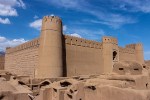 and Mahan, (in one day) and the Kaluts near Shabad,
 the following day he always made sure we had ice cold water dispensed from a tap on the back windowsill, and even served us tea and very sweet Iranian biscuits. Carried our pack breakfast out to us at the Kaluts, where we sat and watched the sunrise and bought us ice cream at Mahan! He was an absolute gentleman. He in addition took us to an underground water vault in Shafi Abad, on the way back from the Kaluts, which was stunningly huge and echoey? 52 steps down and 52 steps up, and worth the visit.
We did promise ourselves a “treat stay/hotel/experience” every 4-6 weeks depending on where and when we were. Kerman was our splurge off our normal tight but flexible Iranian budget. Bearing in mind we had over budgeted by half again before leaving the UK. Yes we paid a bit more for the hotel, but it was amazingly good value, and yes we paid for two car trips out, but they too when compared to UK were amazing value, approx £19, and £23 respectively. Where can you go in the UK and see such stunning natural stunning scenery and man made architecture for such a cheap price. On the whole most of the mosques and public mausoleum/parks museums and parks, or just plain parks cost us little. From as little as 20p! And worth every penny, even a couple that were under restoration.
We are just over halfway through this trip to Iran, (three weeks) and I have not regretted for one moment coming, and if I can afford to I would come again. We only managed to see a fraction of what we would have liked in four weeks. We could have extended but we have deadlines on Turkmenistan and Uzbekistan to follow (not entirely our doing). I have sort of fallen in Love with Iran, its people and its places. I miss that attitude of the Iranians, that everyone is welcome and made to feel welcome, not a threat, something we need to remember and are loosing in the UK.
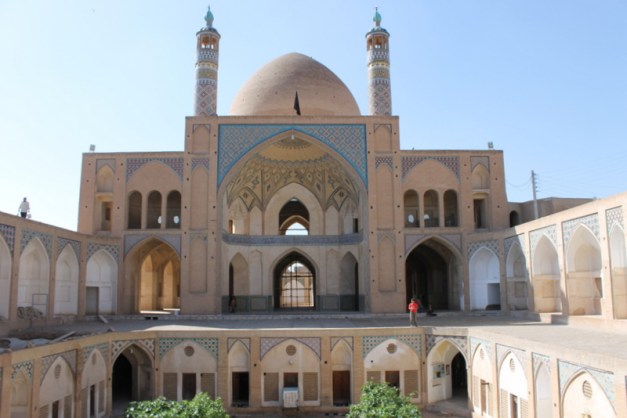
Vali in Mashad was a great guy, he is so knowledgeable and helpful and his wife Esma does actually cook the best food I have tasted anywhere in Iran! Vali’s was our last port of call in Iran before crossing to Turkmenistan, so we shed some 4 kilos of luggage which we dispatched with Valis help through the local major post office, which are usually on the edge of town, but this one was very close to Valis Homestay. We were advised that our parcel would take 1-2.5mths. We took one of Valis excellent tours to Hillside village of Kang.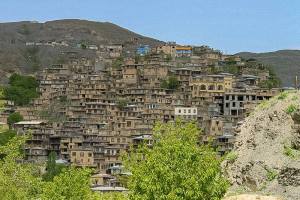
At all times Vali allowed for our lack or levels of fitness, and ability. He was so patient and informative. At no time did we feel rushed. We walked up the winding and stepped, narrow streets looking at the old style buildings that were still very much lived in. The village still has its own Hamam. We also visited by arrangement of Vali, a local lady who served us delicious dried fruit, amazing walnuts, and quenching herbal tea. All of course with an amazing view to boot. Living is Kang is a harsh, they are only just getting gas, and most houses do not have their own sanitation. There was not the usual ringing of mobile phones and inside the houses they were basic, lacking modern amenities. The only exception was the presence of satellite dishes so presumably people do have TV. Having said that, it is a very beautiful village, and a strong reliance on locally produce obtained through the hard work of the locals.
We also had some interesting and lively conversations with Vali, he loves to extend his knowledge of the English Language and many referrals to his voluminous dictionary from English to Iranian were made and we had a great deal of fun with him and his family and other fellow travellers who stayed with him.
During 2012 following the Silk Route of Alexander the Great I visited Iran, and persepolis and this great Necropolis; Naqsh-e Rustam where the great kings of Persia, Darius and Exercese and Artaxerxes I Makrocheir, Darius II Nothus. A beautiful landscape and a place I will always remember….
During my “Silk Route” journey in 2012 I travelled through Iran and of course the route Alexander the Great took to Persepolis the ancient City of Persia. Now in ruins, this UNESCO World Heritage is one that you really need to see to understand and get a feel of. The area of the site is vast and seems to just keep going and going. It is pretty amazing to walk around and imagine how it would have looked in the 4th century.


 Journeys From A Small Room