During my visit to Banteay Chhmar, I saw pictures of the Lions at the Baray (Lake). I have never seen anything quite like this before so this became a “must see” visit during one of our tours.
We reached it at the peak of the day when it was very dry and hot, so we didn’t cross the bridge to the Mebon on the Island. Instead we explored the steps and Lions at the edge of the Lake.
Banteay Chhmar’s baray lies approximately 7-800 metres east of the main temple site and measures some 800 metres by 1.6 kms. Alignment is as per Banteay Chhmar, so slightly north of east-west. The baray today is filled with paddy fields rather than water but a mebon temple is located in the centre of the reservoir.
In 2020, the local authorities have restored the west terrace of the baray, where they discovered a large immaculate sandstone lion buried in the baray, along with a range of other carved stones. The stone terrace has now been restored using old and new blocks to replace those that are too damaged or missing.
What you see in this slideshow is it’s current restored state 2022.
On our return from Banteay Chhmar to Siem Reap (Cambodia), we stopped at this beautiful stone mason’s garden. Whilst I see these as a common feature here in Thailand, and not too dissimilar is this Cambodian one.
Quite often because I am travelling from one place to another, I don’t often have time to stop and take in the enormous amount of work and skill that goes into these sculptures.
They do differ, especially when it comes to the Buddhas/Gods and other deities. I could have spent longer here, photographing them all, but I think this gives anyone a good flavour of what is there.
Starting my visit to Cambodia in December 2022, just around the corner from my hotel was this beautiful and auspicious Wat, Wat Botum.
Wat Botum means “Temple of the Lotus Blossoms” is a colorful temple in the center of Phnom Penh. In Cambodian known as Preah Vihear Wat Botumvatey, the serene and peaceful temple has recently been restored.
Wat Botum is one of the oldest temples in Phnom Penh. King Ponhea Yat ordered construction of the temple during his reign in the first half of the 15th century.
The viharn, the assembly hall, has recently been restored.
Inside the viharn a golden Buddha in meditation pose is seated on a pedestal. In front of it is a Reclining Buddha. The wall behind the image is adorned with a painting of a forest and the Bodhi tree the Buddha meditated under when reaching enlightenment.
The ceiling is adorned with colorful paintings depicting Buddhist stories. Which you will throughout this slideshow.
During my first ever visit to Angkor Wat I tried to do too much and consequently missing great temples (like this one) at the expense of others. Thankfully on my return in December 2022, I was able to visit the ones I missed. This one is The Baphuon Temple. which quickly has become one of my favourites!
\Baphuon is a beautiful 11th century “temple-mountain” with steep stairs leading visitors to a terrace which offers one of the best views in the Angkor Archaeological Park. Archaeologists believe that this pyramid-style temple, located within the city of Angkor Thom, was probably among the most impressive of the Angkor temples in its day.
Though it was originally dedicated to the Hindu god Shiva, Baphuon was converted to a Buddhist temple in the 15th century. As a result of this conversion, hidden on the west-facing section of the third enclosure wall is a giant reclining Buddha. The brickwork forming the reclining Buddha image is nine meters (30 feet) tall and 70 meters (230 feet) long. The statue was built into the west side of the temple’s second level. You may be able to see in my photos about halfway through the slideshow.
And no! I did not climb the stairway! it was too hot and too steep for me!
During my visit to Phnom Penh in December 2022, one of my “must do” visits was the Royal Palace.
On my last visit to Phnom Penh in 2013 the Royal Palace was partially closed, because on 15 October 2012, former Cambodian King and Prime Minister Norodom Sihanouk died at the age of 89, in Beijing, China, after suffering health issues. had died the year before, meaning it was closed for a whole year.
Home to Cambodia’s official royal residence, the grounds of Phnom Penh’s Royal Palace and Silver Pagoda are awash with regal structures, intimate temples, collections of gifts from foreign leaders and murals that paint a picture of the country’s past. Identified by the iconic high yellow walls that shelter the site, the Royal Palace and Silver Pagoda are one of the most popular tourist attractions in the city.
The dazzling, spectacular Grand Palace is undoubtedly the most famous landmark in Bangkok. It’s one must-see sight that no visit to the city would be complete without. It was built in 1782 and for 150 years was the home of the Thai King, the Royal court and the administrative seat of government.
The Grand Palace of Bangkok is a grand old dame indeed, that continues to have visitors in awe with its beautiful architecture and intricate detail, all of which is a proud salute to the creativity and craftsmanship of the Thai people. Within its walls were also the Thai war ministry, state departments, and even the mint. Today, the complex remains the spiritual heart of the Thai Kingdom.
Within the palace complex are several impressive buildings including Wat Phra Kaew (Temple of the Emerald Buddha), which contains the small but famous and greatly revered Emerald Buddha that dates back to the 14th century.
The robes on the Buddha are changed with the seasons by HM The King of Thailand – an important ritual in the Buddhist calendar. Thai Kings stopped living in the palace around the turn of the 20th century, but the palace complex is still used to mark all kinds of other ceremonial and auspicious happenings.
The palace complex, like the rest of Ratanakosin Island, is laid out very similar to the palaces of Ayutthaya, the glorious former capital of Siam which was raided by the Burmese. The Outer Court, near the entrance, used to house government departments in which the King was directly involved, such as civil administration, the army and the treasury. The Temple of the Emerald Buddha is located in one corner of this outer court.
The Central Court is where the residence of the King and halls used for conducting state business were located. Only 2 of the throne halls are open to the public, but you’ll be able to marvel at the exquisite detail on the facades of these impressive structures.
The Inner Court is where the King’s royal consorts and daughters lived. The Inner Court was like a small city entirely populated by women and boys under the age of puberty. Even though no royalty currently resides in the inner court, it is still completely closed off to the public.
Then there’s the impressive Dusit Hall, rated as perhaps the finest architectural building in this style, and a museum that has information on the restoration of the Grand Palace, scale models and numerous Buddha images.
Music free under creative commons licence, from youtube music library
Title: Fern by ann annie
In conclusion of this trilogy of street Art in Kata-Phuket, this area down the sidewalk to the small canal to the Kata beach, suns a wall with more modern and free form murals and wall art.
This area was also earmarked for urban renewal, which as all things is slow.
You can still walk down this canal path and see these murals, there were so many more but I think this gives you a good flavour of what’s there.
So following on from Pt1 ,Kata Palm Square Street Art- Phuket Pt1, I’ll put the link in this video which will take you right to it if you’ve missed it.
The photo project on this area of Kata was quite extensive , so I had to break it down into 3 pts, this is no.2! be sure to hit the like and follow button so you can be notified when they come out in the next few days!
Part of Kata’s regeneration scheme after coming out of Covid, this is a great way of brightening up the area for locals and visitors alike.
Look out for pt3 coming soon!
Music free under creative commons licence from You tube music library
Titles;Bonfire by An Jone
I went to Palm Square, Kata Town in Phuket, you will love this place for two reasons, not only for the excellent food they serve but the amount of brilliant graffiti artwork in and around this huge complex called; Palm Square, and this got me excited for two reasons, I love good Thai food and I love great graffiti work so, I was definitely looking forward to seeing Palm Square in Kata Town and let me warn you there is going to be a overload of graffiti artwork in this post so, I hope you love brilliant graffiti artwork because here you will see some of the best graffiti artists work.
I have broken it down into 3 parts this is Part 1, 2 and three are to follow to be sure to hit the like and follow button so you can be notified when they come out in the next few days!
The Palm Square complex was at one point a abandoned building until a Thai group bought it out, and the builders and graffiti artist got very creative and today a large part of this complex has been completely restored and turned into a very famous restaurant which is called the Palm Square Restaurant. It is well known by the local, expats and many tourists and they Makes for a good place to stop and admire the work.
On the top floor you feel like your working on a tropical island underwater scenes give this feeling, with the graffiti artwork around you, some of the window openings, in the back of the room have been closed up with bricks because the views were not great, they were just looking over people’s roofs so they have been replaced with more aesthetically stunning Artwork. Making it look like your looking out at the ocean, how brilliant! and giving you that relaxed chilled out feeling of Island Life.
It really was like walking through a art gallery, I loved this graffiti, also showing the old and the existing culture of Thailand, just looking at these paintings gives you a view into the culture , Old and new.
Part 2 will focus on the street wall that runs across the road from Palm square. Stay tuned!
Music free under creative commons licence from You Tube music Library
Titles: Find Your Way by Nana Kwab
In 2012 near the start of my journey along the Silk route between Istanbul in Turkey and China, I spent a month in Iran. A beautiful country and actually very hospitable people.
Following the journey of Alexandra the Great to Persepolis, or next stop was the Lut desert to see the amazing sand formations known as “Kaluts”.
The Kalut is said to a sand mountain created by the effect of the dominant erosional agent in desert, i.e., wind making fascinating forms and shapes.
There are no threats, like scorpions or snakes, as the desert of Lut is an abiotic zone, which means that no single plant or creature can survive in such a harsh environment. Rising from the sand dunes, these natural and astonishing sculptures are a real shock to your eyeballs and, while walking among them, you are likely to feel you are wandering around Mars or even better, a Star wars film set.
Music free under creative commons licence from Youtube music library Title: Dakar Flow by Carmen Maria
Wat Phra Borommathat Chaiya stands as the most elaborate example of Srivijaya influence remaining in Thailand today. Built around an eye-catching Javanese-style chedi, the site is thought to have been established when Chaiya was an important regional centre of the Srivijaya kingdom around the eighth century CE. Today the chedi features on the Surat Thani provincial symbol and is mimicked by the provincial capital’s City Pillar shrine.
Many scholars believe that the Srivijaya’s linguistic legacy can still be heard in the Old Malay derived languages spoken in modern Indonesia and Malaysia. Srivijaya subjects also may have been the first to introduce Buddhism to what’s now Thailand and Cambodia, though their Mahayana-dominated form would eventually lose out to Theravada Buddhism from Burma and Sri Lanka. The chedi at Wat Phra Borommathat is one of a handful of ancient Srivijayan monuments that can still be seen in the Chaiya area, with two others found at nearby Wat Kaeo and Wat Long.
First constructed out of brick and vegetable mortar some 1,200 years ago, the chedi was twice restored in the early 20th century. Some alterations were made, including the addition of Thai artistic elements, but the original shape was largely preserved. Those who have explored ancient Javanese temple sites will notice a strong resemblance to the sanctuaries of Prambanan and others. Rising from a square base, its five patterned tiers include shelves, niches and points leading up to a lotus and topped by a slender spire. Buddhist relics are said to be enshrined inside.
Surrounding the chedi on all four sides are ceramic-roofed cloisters filled with Buddha images of various shapes and sizes. Near a Bodhi tree on the other side of the cloisters, a trio of sandstone Ayutthaya-era Buddha images in the Subduing Mara posture sit side by side, exposed to the elements. Local lore claims that these images prefer to be outside, evidenced by a lightning strike on a building they were once placed in.
The temple grounds also include a medium-size ordination hall which, surprising given the importance of the temple, has no murals and only a small collection of typical-looking Buddha images. Stroll to the temple’s northern section and you’ll find a cluster of attractive old wooden buildings that appear to hail from around a century ago.
Music free under creative commons licence, from you tube Music Library
Spirit of Fire by Jesse Gallagher
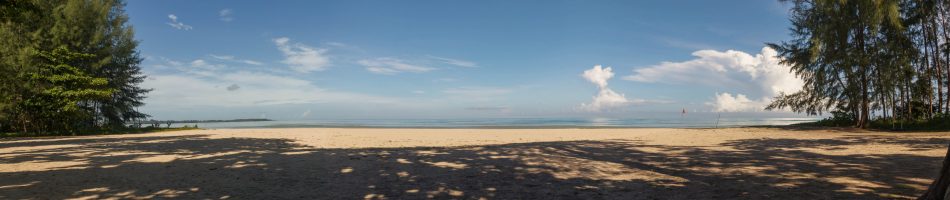
Have you ever heard of Natai beach? Imagine a stretch of white sands ten kilometres long that’s completely free of vendors and beach umbrellas. There are no big hotels, tailor shops or sleazy bars in the area, and absolutely no buzzing jet skis or speedboats.
Where is this magical place? Natai Beach in Phang Nga province just over the bridge from Phuket. With its sands blissfully free of vendors and sunbed rentals, to spend a day at the beach is to be immersed in a Natai nature nirvana soothed by the sound of the waves.
The balmy turquoise waters are ideal for swimming, surfing, stand-up paddling or kayaking. A bit like the Hamptons of Southeast Asia, with strict local building laws have shielded Natai Beach from all mass development. Instead of mega resorts and shopping malls, the beach is lined with a handful of boutique resorts, private villas and high-end restaurants.
Except one, Raipiang seafood restaurant, which does cater to more normal budgets and offered delicious seafood. Sitting here watching for a sunset dinner, not as spectacular as it could have been, but oh so lovely all the same.


 Journeys From A Small Room